Could a framework change the way you think about your time, your strengths, or your team? In this episode, Helen and Sarah borrow brilliance from three tried-and-tested strategic models, and put them to the test with AI prompts, Post-it® Big Notes, and a live coaching conversation to see how useful they actually are.
From a classic time management matrix to a strengths development tool to a team effectiveness framework that’s been around since the 70s, this episode is brought to you in partnership with Post-it® Brand. If today’s episode sparked an idea, stick it down, find out where to buy Post-it® products.
🎯 What You’ll Learn
– How to use the Eisenhower Matrix to see where your time is really going (and what to do if it doesn’t give you new answers)
– How to adapt the Ansoff Matrix to grow your strengths into new contexts and with new people
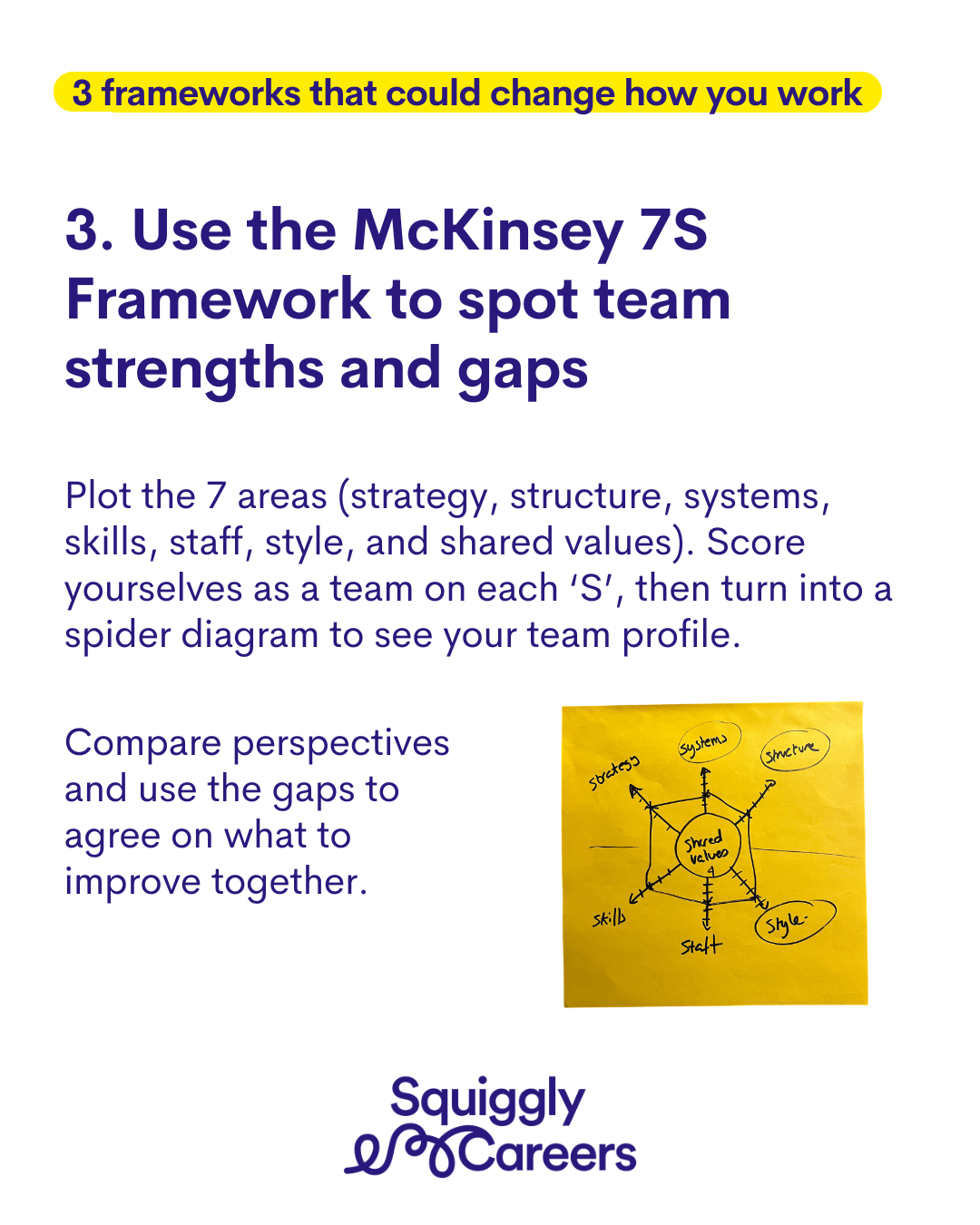
– How the McKinsey 7S framework can reveal surprising gaps in how your team works together
– Which frameworks are best done alone, in a pair, or with your whole team
– How AI can help you get more from a model that feels too simple on its own
For questions about Squiggly Careers or to share feedback, please email: helenandsarah@squigglycareers.com
Need some more squiggly career support?
1. Download our free careers tools
2. Sign up for our Squiggly Careers Learn Like a Lobster Skills Sprint
3. Sign up to the for Squiggly Careers Newsletter, a weekly summary of the latest squiggly career tools
4. Order our new book Learn Like a Lobster
00:00: Introduction on borrowing brilliance from strategic models
03:43: Framework one… The Eisenhower Matrix
07:46: An AI prompt to help you decide what's most important in your career
13:44: Framework two… the Ansoff Matrix
30:01: Framework three… McKinsey 7S framework for assessing team effectiveness
40:17: Closing remarks
Sarah Ellis: Hi, I'm Sarah.
Helen Tupper: And I'm Helen.
Sarah Ellis: And this is the Squiggly Careers podcast, where every week we borrow some brilliance from a person, a place, even an object from time to time, and we turn that curiosity into useful action for your career.
Helen Tupper: And today, we are borrowing brilliance from strategic models.
Sarah Ellis: I've never seen Helen look so excited. She's got her pen ready.
Helen Tupper: I have got my Post-Its. I've got my pen. I am ready with frameworks. This is like my happy. My happy moment. Also. It is another one of our episodes that is in partnership with Post-It. So I just get to bring together all the things I love to help you learn. And this is my dream.
Sarah Ellis: I feel like they've just given you another excuse to be like, right, okay, we can just have more matrices. Okay, so.
Helen Tupper: But I will say today is a bit of a combo day because we are definitely going to be using the Post-Its to bring the frameworks to life, because I just find it's like a very useful way of thinking. But we have also got some AI to. To just, I think, to connect. To connect the two things so that you can learn a bit more from them. And, yeah, my love of frameworks and models is. I mean, it's no surprise, I think, to anybody who regularly listens to the podcast. I can't help.
Sarah Ellis: It's not a surprise to the people who asked you to sign their book and you started drawing models in their book.
Helen Tupper: Well, it was. Well, I did it for one person. So when I was in. I think. Was it Canada? I think it was in Canada. It was after I'd done a keynote and the company had bought books to support the keynote and people wanted their book signed at the end, which. I'm always amazing. It's always amazing. And it's always like, oh, my gosh, this is crazy. Anyway, it's like a little. Little queue of people because I think once one person starts doing it, everyone's
Sarah Ellis: like, oh, it's okay to do it.
Helen Tupper: I'll get my book signed. And then somebody. Normally it's just like, oh, my name's whatever, and I sign the book. And then someone said, oh, well, I've got you, I've got a question. And I'm like, okay. And someone. So someone asked me a question, and then I was like, oh, I do. I've got a framework that will help that. So I started doing a framework at the back of the book. And then there were probably about another 10 people after this person. And then they basically said, can I have a Framework too.
Sarah Ellis: What? Like any framework.
Helen Tupper: I was like, pick a framework.
Sarah Ellis: Any framework.
Helen Tupper: Like, what's, what's the challenge? And.
Sarah Ellis: But it was like, I mean, that would be quite a good quiz, you know, if I said to you on the spot, here's, you know, like, if our listeners said, here's a problem, like, what's a framework? To help you think through that problem, we should, at one point, you should put something on LinkedIn and ask people for, you know, like, something they. Like a dilemma, a decision, something they're stuck with.
Helen Tupper: Yeah.
Sarah Ellis: And then we should see whether you can come up with a framework for it.
Helen Tupper: Oh, my gosh. I'm kind of like nervous about that, but also like a little bit. A little bit excited.
Sarah Ellis: Yeah.
Helen Tupper: Yeah. Well, today, three tried and tested frameworks that are. I think they're quite old school. Like, one of them, the last one we're going to talk about was developed in the 70s and we studied it when we were at University in 2001. So this has been around for a while.
Sarah Ellis: It's a good stress test. Have they. Have they stood the test of time? Yeah.
Helen Tupper: And also, like, can AI, which wasn't around when we first learned about them. Can AI add any additional value to them? I think is a useful, a useful take on it. So we've got three frameworks. One is about time, like your time. One is about your skills and one is about you and your team, so kind of help you learn in different ways. So plan is I'll draw them to bring them to life. If you are listening, please don't worry, I'll describe it in a way that's kind of easy to follow. If you're watching, I will hold up my lovely. The.
Sarah Ellis: These are my favourite big notes. She's got the big notes.
Helen Tupper: These are Post-It big notes. And these are the ones that people always ask us about in sessions. And we have them all over our office and our desk and we take them with us. So I'm going to draw it on these and show it to the camera, but I'll describe it for anyone that's listening. And then I am going to use Sarah as my kind of guinea pig to kind of let us know what you learn.
Sarah Ellis: I've done AI prompts as well.
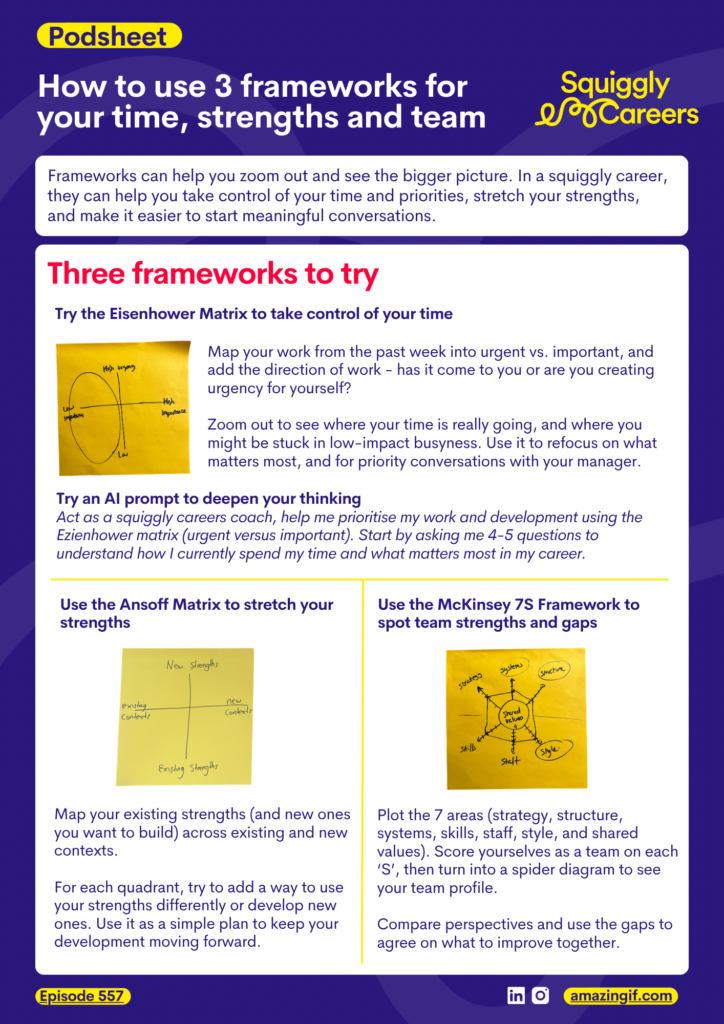
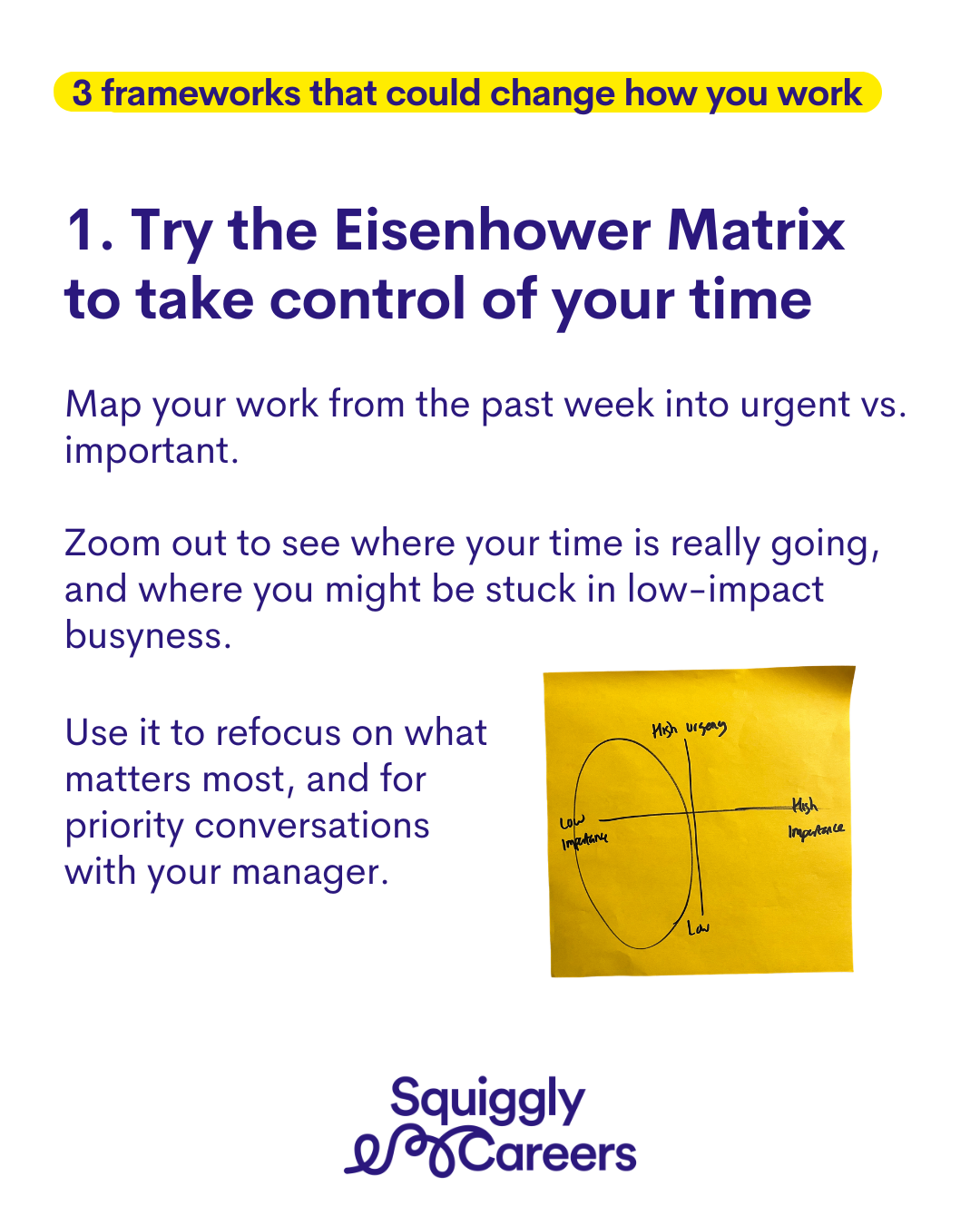
Helen Tupper: Okay. So we're going to start with the first one, which is about time - the Eisenhower Matrix. And people will probably know this one is like the urgent, important matrix. So it's a, it's a two by two matrix. And so you want to think about your tasks in terms of what is kind of high urgency needs doing today. Like panic, panic, panic, got to get done. And that's the first one. And then you also then have high importance, so feels, you know, strategically important to the team, maybe valuable to the company versus low importance, maybe this is kind of, I don't know, the territory of busy work. So you end up with a matrix a bit like this and you want to think about your work on where it is in these different quadrants. Obviously the aim is that we're working on the most important work, but I think it's quite a good thing to draw the matrix, maybe look at your last week or your last month and see how your work is fitting into these different quadrants and whether you don't basically want too much that's over this side of the matrix. So kind of low importance work is not really what we want. You get into like busy territory here or not. Great use.
Sarah Ellis: I guess the trap that most people fall into is low importance, high urgency. You know, like, I think that's a familiar feeling for lots of people. Firefighting, firefighting, troubleshooting, responding to everything in your inbox or on your team's messages, like the minute it comes in. And then you can get to the end of a day or the end of a week or even the end of a month and be like, have I actually done anything that matters most? And so I think getting sucked into urgency and sometimes I guess also it's not even your own urgency, it's urgency created by other people that might be like us. Right. We send something to our team. I actually think the team gave us this example recently where, you know, like if, if we say, oh, could someone take a look at this please? Then actually everything else stops because people think, oh, they want to be really helpful and supportive of us. Yeah. And you know, if we've not signalled how important it is, suddenly that that becomes the most urgent thing and someone didn't know that that was going to then really disrupt their day. So I think that's often that's what I think people are starting from. And I think the point is, does this help move people to the important work, whether it's urgent or not?
Helen Tupper: I guess I also think that's a good build on this model. I think you can maybe once you've put all your work in the different quadrants and you can kind of maybe try and zoom out and see what is this what is this telling me about how I'm spending my time? I also think you could potentially put an arrow on, like, what is the direction of that work? Like, has it come to you and who's from. Because I could do it and I'd be like, oh, my gosh, Sarah sends me all of my, I don't know, like, hi, this is not true. Like, all of my urgent, not important stuff basically comes from Sarah. And then you kind of reflect on, oh, well, why is that? Maybe I need to give that some feedback that that is taking me away from the, like, the more important work for me to do. So, yeah, maybe arrows also you could do like little asterisks. Like, am I creating this work? Yeah, like, that's probably one of my reflections is some of this stuff, like, I create the deadline, I create the urgency, because I've got to get this done by Friday, but do I?
Sarah Ellis: Yeah, that's interesting. Are you creating the urgency? The other thing you could map is how that work relates to your objectives or the outcomes. So if you were looking at, you know, if you were going, I'm doing this task or that task this week, how many of the things on that matrix then relate to what you're trying to achieve over the next quarter? You know, like zooming out to bigger priorities. Because I would guess if it's all high urgent, low important, you're probably not making progress on your, like, the big priorities.
Helen Tupper: So Sarah's going to tell us what she learned from this in a moment. But what I will say is, I'll get it ready. You want to get this, like, this framework. And if you want the prompt that Sarah's going to talk about, because we use an AI prompt, we'll put it all on the pod sheet and you can get that from amazingif.com just go to the podcast page and it'll be there. But Sarah is going to let us know what you learned by using this. Did it help you think about your time?
Sarah Ellis: No.
Helen Tupper: Okay, thanks for that.
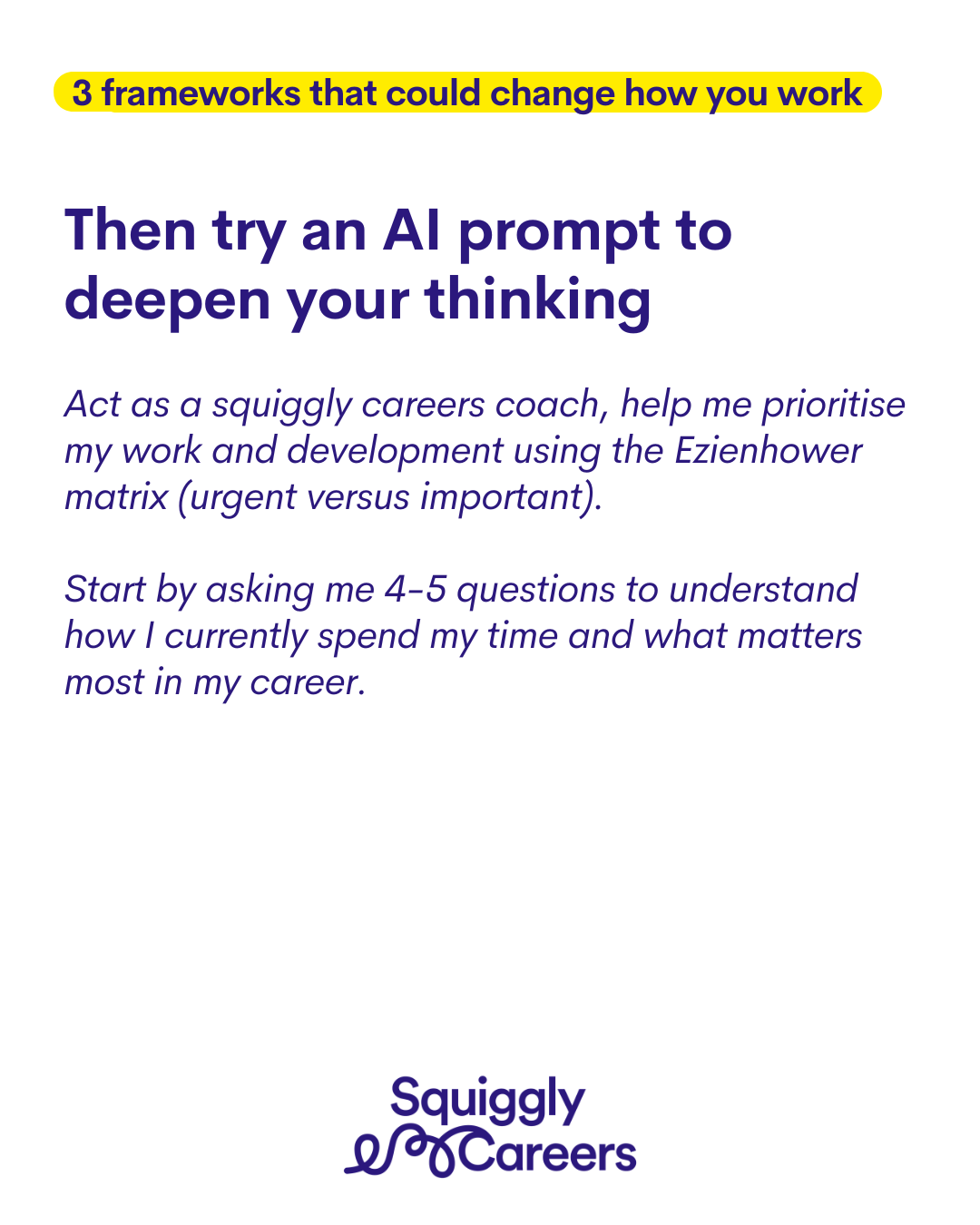
Sarah Ellis:. So the AI prompt was useful as a starting point. So you'd written this. It was is along the lines of, like, act as a squiggly careers coach, help me prioritise my work and development using the Eisenhower matrix, urgent versus important, and start my asking me four to five questions to understand how I currently spend my time and what matters most in my career and actually what I like. So I use Claude, because that's my favourite. And the questions actually were kind of multiple choice. So it did mean, I could do it quite quickly.
Helen Tupper: Yeah.
Sarah Ellis: Which I was like, oh, I've not really got time to, like, do really long answers right now. And I'm trying to get a fast feel for is this useful? So I actually liked how the AI guided me through thinking about this. And then it did give me a matrix with, you know, multicoloured, like, traffic, like dots on, around, like, what should I schedule, what should I drop, what should I delegate, what should I do? But it was all things I already knew.
Helen Tupper: Okay.
Sarah Ellis: And I think sometimes there is a difference between what you know and then your reality. So in some ways I was like, oh, I just find that frustrating.
Helen Tupper: Can I ask a question? Because, you know, you're like, I already know this. Let's imagine I was your manager. Or even, to be fair, I look as a business partner. Do you think it would be helpful to show me that, you know, if we were going to have a conversation about your time, that thing that it's got, and it's like, done the traffic lights, do you think that would help us to have. If you were feeling like, I'm not sure my time's been spent on the right things. Would that help us to have a constructive conversation about it?
Sarah Ellis: I think having a conversation with your manager about together agreeing what's most important would always be useful. Especially because, you know, never assume. I sometimes think you might think Project A is most important and then somebody else might be like, oh, but I thought Project B was. So I always think the more transparent you can make what you are working on and what you believe the priorities to be. Someone in our team did it this week. They sent us both a message, actually, and they were like, this is what I'm doing. And you really quickly replied and went, well, of those things. These are the two. And so it wasn't like you were in very different places, but you probably helped to create some extra clarity on this. Like, you know, there's like, important and then there's really important. So I think, I think it would help whether I would do it in the matrix. Not necessarily, but I think the question about important and urgent is probably useful. I then use it as a sort of springboard to think, well, what else? So I was like, well, if that's. If I don't find that that useful. And I've actually asked people this before in workshops. Everyone, I think a lot of people know this matrix. And then when I say, how useful is this matrix for you? Out of 10, everyone gives it quite a low score. And I think that's because you just go, everything feels urgent and important.
Helen Tupper: Yeah.
Sarah Ellis: And it's sort of, you know, like you don't change, you don't do anything differently because of it. So I'm like, well, how. How useful is it? So I write this tool doesn't offer me any new insights, what other tools might be helpful for me to consider. And then what I liked about it, then it starts to feel more kind of creative because then it starts to say, well, have you looked at the wheel of work? Have you looked at energy mapping? Have you looked at horizon modelling, which is. Splits your work into now, next and future, like different time horizons. It was talking about OKRs, objectives and key results. And then it prompted me to think about the rocks, pebbles and sand approach. And again, it described it to me and it's like your rocks are like your biggest, most important things. You sort of put those in first into like a jar, then you put your pebbles in and then you kind of sand. And it's sometimes thinking, what are my rocks? What are the pebbles? What's the sand? And am I doing the right work in the kind of the right order? So I think for this first one.
Helen Tupper: Do you know what, though? Just to pause on it. That's such a Sarah thing, you know, like, the reason I'm saying it is because, like, frameworks are, I think, or I find them, frameworks are designed to sort of simplify and clarify complexity. And then basically what you've got is going, not this, but it could be these other six and a combination of these and in the middle there's something new.
Sarah Ellis: It's just.
Helen Tupper: I just think how to take a framework for simplicity and make it thoughtful and more extensive is basically your brain.
Sarah Ellis: You're not saying it's like more complicated, but I think it's because time management and productivity is always such a popular topic. Like, whenever we cover it, everyone's always really interested. And I think if you try to get. It's almost like too simplistic in the answers, it's almost. It's not that helpful. And so I don't think there is. Probably because you're hoping there's going to be a silver bullet, right? You do this and you think, oh, help me, because I'm spending all this time on this urgent stuff and it's frustrating and you probably know it's not what matters most, but it's quite hard, it's quite hard to make that shift. And I think, well, when things are hard, probably an urgent, important matrix is not going to. It's not Going to be the big thing that makes a difference. But what I would encourage you to do is I think it's a really good starting point. It almost doesn't matter whether the model works for you or not. What matters is then the critical creative process you then go through. And that didn't even take me very long. That was probably less than 10 minutes worth of time. And it's got me thinking, right, so you might do it and fill in the Matrix and be like, done. I go in a very different direction.
Helen Tupper: Doing a bit more, but.
Sarah Ellis: But helpful in different ways.
Helen Tupper: Yeah, yeah. Okay, so maybe you're giving that in, in of itself a usefulness score of one. I'm gonna give the Eisenhower matrix a score of three out of five.
Sarah Ellis: Oh, oh, I thought I was out of ten. I was going one out of ten. What are we doing it out of
Helen Tupper: one out of five?
Sarah Ellis: I'll stick with one.
Helen Tupper: That's fine. I'll stick with one. Let's move on to our next one.
Sarah Ellis: Your scale was different to what I'd imagine
Helen Tupper: Okay, great, Great everyone.
We're on the way up the next model. This is like one of my favourite ones and I think I've used this in lots of different ways in my career. So. So this is the Ansoff Matrix.
Sarah Ellis: Maybe we need the Ellis Tupper matrix.
Helen Tupper: Oh, my gosh.
Sarah Ellis: Tupper Ellis Matrix.
Helen Tupper: Who's coming first? I don't know.
Sarah Ellis: I don't know. You always come first in the book. So we have to be consistent.
Helen Tupper: It's practical, it's not like an ego thing.
Sarah Ellis: Oh, that's cause you first name.
Helen Tupper: Oh, yeah.
Sarah Ellis: It's not like I was like, that's not right. Tupper Azo. Took me a moment there.
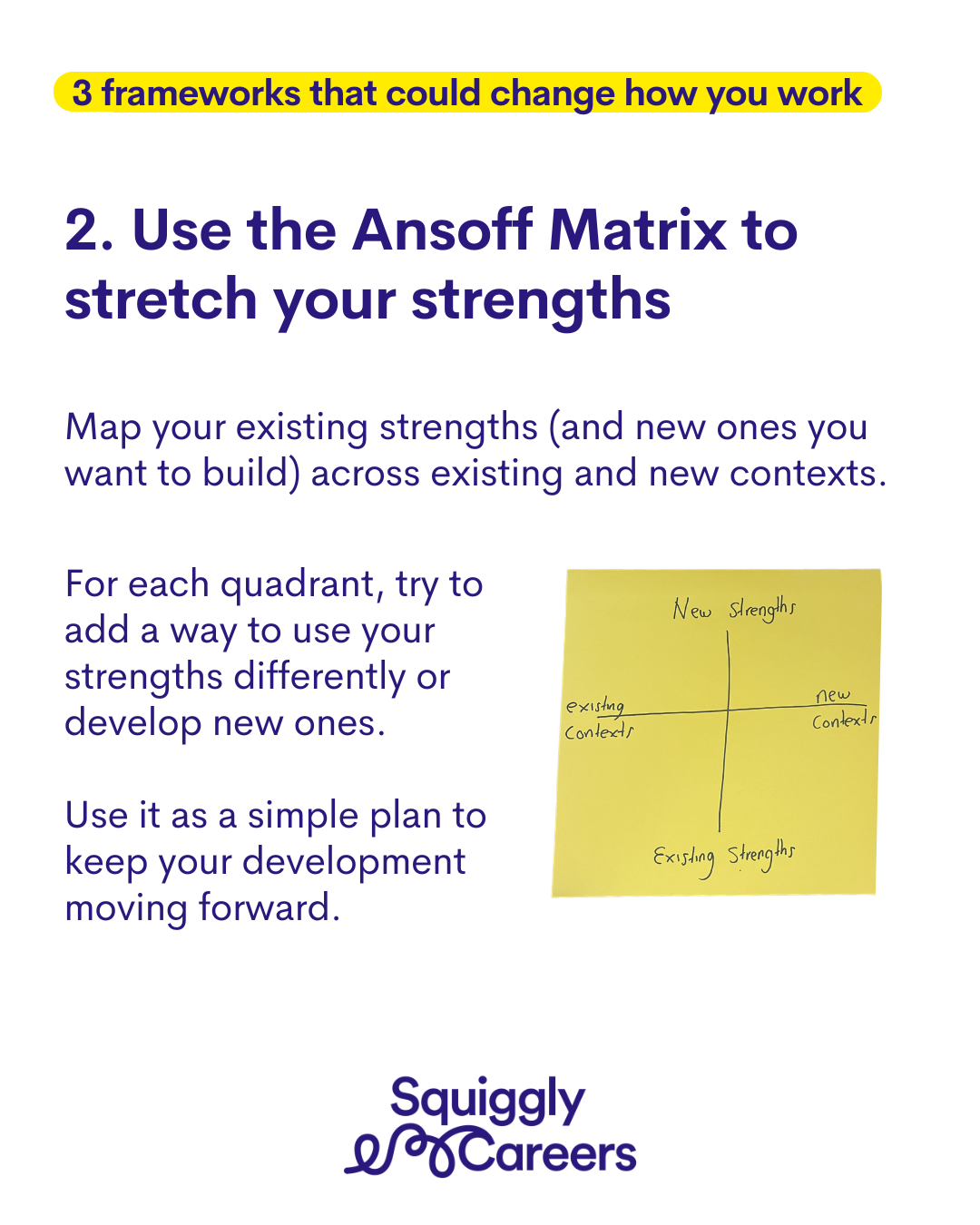
Helen Tupper: Oh dear. See how fun frameworks are? Okay. Ansoff Matrix. So traditionally this is a matrix that is more about products and innovation. So I think that's where I've come across it in my career. So again, I'll draw it. It's another two by two. They're not all two by twos. The next one is a spider diagram. There's a bit of a tease for what's coming, but this one. So traditionally it's about thinking about your products, like as a company and how you can like take them into new areas. So traditionally you think about new and existing products and new and existing markets. But we are going to scrap products and markets and we are going to think about skills and kind of your context. So we're Going to think about what new skills you could develop and what existing skills you've got. And we're going to think about what new contexts you could use them in and what existing contexts you use them in. So you'll end up with a two by two matrix that looks a little bit like this. And each of those has an opportunity for you to use your skills and strengths differently so that they are less likely to stagnate. So I think that's the payoff here. If you don't do this, you're in danger of using the same skills with the same people and it might slow down your development. But if you start thinking about what new skills could I use with the same people or what existing skills could I use with new people, you start to unlock different ways that you can use your strengths.
Sarah Ellis: I have a question. Yes, please ask. Okay.
Helen Tupper: Yes, ask.
Sarah Ellis: I feel like you're like, no, because we're just trying to fill in the matrix, Sarah. So when I was thinking about this, because I do know that you're going to talk it through with me in a moment. Should I be thinking about my strengths or my skills? Because I got to different. Sorry, you're like, oh, no, no, it's
Helen Tupper: a good, it's an interesting.
Sarah Ellis: Because I was like, oh. I could see this as a way of. We often talk about like, no, grow. Show your strengths. So I was like, oh, is this a way of thinking about my strengths, the things I really want to be known for, or is it broad? I think probably broader would be skills because I, I do find them two, two different lens.
Helen Tupper: No, no, I agree, I agree with you. I agree with you. I think they say the distinction when we talk about strengths. This is what gives you energy. What do you want to be known for? So you filtered it.
Sarah Ellis: Yeah. Down a shorter list is strengths in my mind.
Helen Tupper: Yeah. And the benefit of that is the, the harder you work, the things that you want to be known for, the bigger the payoff there is for your
Sarah Ellis: career and impacting your jobs.
Helen Tupper: Right. But the skills is a broader set of things. Things, some of which you might be good at, but you might not want to be known for. I think we should just decide what to do for the purposes of this conversation now, however, I actually think there's a benefit in maybe running this model through both and just seeing. Because there could just be some skills in there that you think, well, maybe that is an area for me to work on a bit more. I haven't kind of owned it as a strength now, but probably in the Future. So I wouldn't want to. I wouldn't want to, like, block out opportunity by.
Sarah Ellis: That might be a good thing to experiment with.
Helen Tupper: Yeah, I think experiment. Do it once with strengths, the things you want to be known for, because that's probably got the most immediate payoff. And then maybe run it again with skills, things that you. Maybe you're starting to develop. You don't even know if it's a strength yet. It could be some opportunity. Which one do you want to do for the purposes of this chat?
Sarah Ellis: Let's do strengths.
Helen Tupper: Let's do strengths. Crossing off skills.
Sarah Ellis: Oh, sorry.
Helen Tupper: It's fine. I can cope with a messy. A messy.
Sarah Ellis: Oh, no, it already looks messy.
Helen Tupper: All right, Sarah. Right, okay. Let's start with. Let's start with the bottom box, the one where people mostly get stuck. So let's go with existing strengths.
Sarah Ellis: Yeah.
Helen Tupper: So things that give you energy, things you want to be known for, and kind of your existing context. So this is like the territory of today. What's going in this quadrant?
Sarah Ellis: Okay. So presumably first you've got to start with what those strengths are. So if I was starting, I would say, okay, let's. For the purposes of this, let's use like, developing ideas.
Helen Tupper: Yeah.
Sarah Ellis: Creative thinking. Yeah, that is my territory. And so how I'm using it today would be coming up with ideas for how we can be useful for careers. Like, that's like the most zoomed out version, but. But it might be things like. Okay, what are we gonna do for a podcast topic? Yeah, that's like. Yeah, that's an idea. So a podcast topic. It could be an idea for something to run in a workshop with the companies that we work with. It could be an idea for a LinkedIn post. So it would sort of be connecting, helping people in their careers with, like, coming up with new ideas.
Helen Tupper: Okay, and how do you think you could do that better today?
Sarah Ellis: I think I could give myself more space to do that. I think quite a lot of what we sometimes do in some of our work is we're iterating on what we've already got. And I actually really like starting from scratch. Clearly based on the first matrix we talked about. And I think back quite fondly to when we first developed some things that we did develop from scratch together. And we don't do that as frequently anymore. We probably don't quite have the space for it. And in some ways you don't have the need. You don't have the need.
Helen Tupper: Right.
Sarah Ellis: Cause we've got things that work really well. We know. Are really useful. So I think I could do that more by almost giving myself permission to try out new ideas more frequently. And I just think I just don't anymore.
Helen Tupper: I'm going to write as an action there more space to start from scratch. Yeah, I was gonna call it scratch space, but that just sounded a bit weird. Scratch space. So we need more space to start from scratch.
Sarah Ellis: Okay.
Helen Tupper: Okay. So let's do take those things that you know you're good at that give you energy that you want to be known for. So like the ideas and creative thinking. But now let's think about how could you use those same strengths but in a new context.
Sarah Ellis: Okay, so by new context, do we mean like new company?
Helen Tupper: So we could go new people, we could do new places, we could do new projects.
Sarah Ellis: I never help anyone else with how to do that, come up with ideas. And often if I talk about that being something that I'm good at, you know, as an example, people would be like, oh, I'd like to get better at that. And I, I don't think I've ever thought about what helps me to do that. Well, partly because it's a natural talent. Easy to take your natural talents for granted. Partly because I probably haven't seen a like a when. Like when would that be useful? You know, we don't talk about creative thinking in our workshops. We're talking about strengths and values. But that would be a different take on a strength I've got. And we know by sharing your strengths, you make them stronger. So it's a good payoff for me. Maybe some people would find it useful.
Helen Tupper: And so just on the some people, our team. Who do you think? Well, I'm thinking new context.
Sarah Ellis: Oh, new context.
Helen Tupper: New context. So who else other than who you already work with. Yeah, me, the team. Who else do you think would benefit from having a Sarah how to on coming up with ideas?
Sarah Ellis: Well, I guess people may be in our squiggly careers community.
Helen Tupper: Yeah.
Sarah Ellis: Might find that useful. So we could. Maybe I could do a newsletter takeover.
Helen Tupper: I mean,
Sarah Ellis: she's writing it down. That's always dangerous.
Helen Tupper: Equals idea takeover.
Sarah Ellis: I could do a takeover of our own newsletter.
Helen Tupper: Yeah, you could. I'm going on holiday soon, so if
Sarah Ellis: you are going to do it that week. Yeah, to be fair, I think I am doing that week.
Helen Tupper: I have.
Sarah Ellis: When I do write the newsletter, which is few and far between, I always get a very good response. So I listen to you that you have to do it 80% of the time. But then occasionally I come in and I'm Like Helen's on holiday. Hi everyone. And they're like, oh, it's so amazing to hear from you. So maybe I could do that.
Helen Tupper: Okay.
Sarah Ellis: I guess I could also think about creative communities because they will sort of more the worlds that we both kind of used to work in, but it's been much time in that world anymore. And there will also be maybe I could share what I do, but I would also probably learn quite a lot from that. I actually was at a marketing event this week and actually I did stay for the whole event, which is sometimes we can't always do, you know, you have to turn up and then do other things. But I heard quite a lot of people where creativity is their full time job. You know, their job is to come up with ideas, talk about their perspective on like how to do that and why that's so important. And that was that. I found that really kind of inspiring. But also it kind of gets things fired up in my brain about like how I do that and kind of what I believe in.
Helen Tupper: Also, I was just thinking the Squiggly students, which is a new thing that we are doing that we've launched this week. We launched this week with upReach. And that is a, you know, that is a group of people who I think could really benefit from your ability around ideas because it can be applied to so many contexts.
Sarah Ellis: Also, they got some really good ideas, right?
Helen Tupper: Amazing.
Sarah Ellis: We were doing experiments with them on how to sell study and they were just so good. They were so good at coming up with ideas. Yeah, right.
Helen Tupper: I was like just writing that down for myself.
Sarah Ellis: Thank you.
Helen Tupper: Thank you very much. Okay, so now we are going to go into new strengths. Okay, so this is, this is kind of going beyond the things that you kind of already know that give you energy that you're good at, into kind of things that you think I want to get better at. That there is an opportunity for me to develop that further. Or maybe it's something that you haven't even started yet, but you're kind of interested in it. And we're going to think about that from the perspectives of how could you use those new strengths with the people that we currently work with that could be me or the team or the companies. And then kind of the most out there is the new strengths with a new audience. So let's start with the one that I think is slightly, slightly easier, which is kind of your new strengths, but with the same, in the same context. So, okay, what new strengths would you like to invest in?
Sarah Ellis: I would like to invest in a new strength around converting technology into kind of taking some of the creativity that we've talked about. So it's not completely new, but kind of using technology to bring some of those things to life, like faster. Because I feel like there's untapped opportunity with some of the good things that are happening in AI. Not all AI is good and we shouldn't use AI to replace creative thinking. But you and I having, you and I, we were having conversations this week about things that Claude have launched, how it links to Canva and Claude Skills. And I sort of have a sense of. I don't know whether strength is the right word. That might be more of a skill. Now maybe I'm combining two things, which you definitely probably shouldn't do. But, you know, like the. I feel like if I viewed some of that new AI as like a creative opportunity, a. I would have a different relationship with it. But I'm not like naturally super interested in like tech generally. You know, some people are just super techy. But I am really interested in creativity. So I kind of go, if I could combine sort of my interest, maybe some of the skills and strengths I've got with that, if I could get good at that or at least good enough, I feel like there's value, value to be had.
Helen Tupper: Okay, so let's just explore the value to be had. So if like a new skill slash strength area for you is using tech to kind of create faster, like maybe prototyping, um, how do you think that could benefit your existing, your, your existing context? So me, the team, the people, companies
Sarah Ellis: we work with, well, I think even like almost like every idea you come up with, you could just create something really fast to show people what's possible. And I, I think sometimes people are surprised by what you can do in not, not loads of time. So I think if you can show that you've done it and if you can talk about, you know, if you can show your workings. Yeah, I think that really helps people to feel confident that they could do that too. So that's how I think it would help people because they would know, oh, she's an amateur. Like, she doesn't, you know, she's, she's not like, she's so good at this. But if I could say, oh, well, I've not used Claude skills before. I've not done any Claude code, so this is how I've used it. This is what it looked like. This is where I got stuck. I feel like that might be helpful.
Helen Tupper: Love it. Nice role modelling. I put it would make ideas tangible and increase confidence.
Sarah Ellis: Yeah.
Helen Tupper: Which is a nice announced outcome. All right, let's do this last one then. So this is the kind of. These new. These new abilities. It could be that one. It could be this kind of AI to. Or tech generally to create faster, but with new people complete. So it's not team, not me, not companies that we work with, maybe not even the squiggly quiz community. This is a really open area, I think, for development.
Sarah Ellis: I'm always interested in how we could do more to support charities. And that would be a new. We don't work with loads of charities. We have lots of free stuff that charities can use, and I. And I hope that they do, but I couldn't name, you know, like, oh, 100 charities that we work with or work that we do specifically for charities. And I, And I used to do a lot of work with charities in my old job when I was like, looked after corporate responsibility. And I've got, like, lots of connections in those kinds of worlds. And I always feel like I really want to support people who have also made that choice, you know, to go and work in a charity. And they're not easy jobs. And lots of those charities, you know, their funding is so. Is so hard. It's such a. It can be such a tough place to be. So I do hope they're making the most of our stuff anyway. But, you know, if you had that lens of like, okay, we're going to do something specific for charities, what would that look like? And could you combine, I don't know, the best of some squiggly career stuff with some of that AI work and what charities need or what would be most useful for them? I feel like there might be something there that could be. Could be helpful. I don't know what yet.
Helen Tupper: I don't know. Well, I guess that's the kind of unknown area, so it's good to keep that one unknown. I just think. I don't know if it's still going. Do you remember Pimp My Cause? Yeah. Years ago, I used to kind of get involved in that, and I haven't done for a while, still going, but I think, you know, using kind of tech to create faster, that that could be a really good way that you could help accelerate maybe what a charity is thinking about doing. You can say, oh, you know what? We've. I've developed this skill in this context, but actually I could bring that skill to yours and benefit you in a way that I find meaningful and you find Valuable. Okay, so we've gone through an soft matrix and we kind of. We narrowed it down, didn't we, to do strengths rather than skills. What are your. What are your thoughts? Having gone through that conversation together, it
Sarah Ellis: definitely makes you think about often when we say to people, do you feel like you know your strengths? I think most people have a pretty good idea of at least some of their strengths. But it's often the grow bit that people struggle with. Like, well, how do I make my strength stronger? Where else might I use it? Who else might I use it with? And my reflections is, that is a bit harder. So it's really helpful to have someone to talk to because it gives you just a bit of space to think and you could prod a bit or nudge a bit or if you were like, well, not quite what we're trying to do here, you know, you can sort of just keep asking a few more questions. So I think whether you do it in conversation or you do it with AI and I also did do this with AI as well. I think it is helpful not to sort of do this by yourself. This is one where I think you do need a few prompts. And I did actually feel like, as I was going through, funnily enough, I felt like actually just using my strengths was a bit limiting. So it made me think, having gone through it that way, I started there thinking, oh, that's helpful, because I want to stretch my strengths. And then I was like, actually, if I was going to do it again, I think I would maybe start with five skills, including a strength.
Helen Tupper: That was where I got. That was like my inner in a chat was like, I think we could learn more.
Sarah Ellis: I think if we learn your skills through this. But I think one of those should be your strength.
Helen Tupper: Yeah.
Sarah Ellis: So I think. I think if you just did what I did, you kind of get to like, oh, okay, you know, still, that was still, like, helpful.
Helen Tupper: You start to run out at the top. Yeah, yeah.
Sarah Ellis: Whereas then I was like, oh, but if I just. In skills, like, well, how good is. How good is my creating, like, new models in AI skills? Then you're like, okay, you can sort of have a play with that.
Helen Tupper: Yeah, yeah.
Sarah Ellis: Which is probably why they put skills. Well, you put skills.
Helen Tupper: They didn't put skills.
Sarah Ellis: We've adapted it well.
Helen Tupper: I was open to the adaptation.
Sarah Ellis: So, yeah.
Helen Tupper: So the first one, Eisenhower, good to do on your own, maybe this one,
Sarah Ellis: I think you've got to do it
Helen Tupper: with someone good to do with someone, like in a.
Sarah Ellis: Or something.
Helen Tupper: The third one, which is our third and final framework for today. I think this is a really good one to do in a team.
Sarah Ellis: Yes.
Helen Tupper: So this is the McKinsey 7S framework. I really remember learning this by Peterson Waterman. Let me remember that.
Sarah Ellis: That sounds like a, you know, like a record label.
Helen Tupper: Yeah, it does. Why does that? Was there something bad? I don't know.
Sarah Ellis: I think there are some that sound a bit like the 80s or whatever, maybe earlier.
Helen Tupper: Gosh, yes. This is like from the 70s. So there are seven S's, which I will try to remember. And if I can't, I've got.
Sarah Ellis: I've got. I've got the definitions ready to go for you.
Helen Tupper: Great. We'll do this. We'll do this together. And this is more of a spider diagram, so I'll kind of draw it and then I'll hold up the camera. But as I said, if you're listening, I'll describe it and we'll put it on the pod sheet anyway, so you can see it there. But it's effectively a framework for analysing, like, I think, like, how effective your team is likely to be. It's sort of like team effectiveness. There are these seven things that contribute to team effectiveness and you're going to take a critical lens of these against your team and give them a score. Again, you can pick what score you want to do, but we'll just do like up to five. Where one is, we're rubbish at this, five is we're great. And then it helps you to see, you know, where have we got some strengths in our team? Where have we got some gaps? So Sarah and I are going to talk it through to sort of bring it to life and we'll use our team as context. Sorry, team, if you're listening, but we want to do this as a kind of a live way of reviewing it. But I think. I do think there's maybe a benefit if you're a manager, maybe you doing this so you've got a view and then doing it with your team and then just contrasting. Does your perception match their reality? I think would be useful. So in the middle we're going to put shared values. What is the definition of shared values, Sarah?
Sarah Ellis: The organisation's core values ties everything together, where all aspects of the organisation operate under the same set of values. So I think this would be. If you were a team, it's like, well, do you know what your probably company values are? Most teams don't have team values that are separate to company ones. So do you know your company values and do they, I suppose, impact or inform the work that you do as a team? Like, are you connecting the dots between what you do as a team and the values of your company? That's probably what I would be asking.
Helen Tupper: Give us a score.
Sarah Ellis: Oh, as a score?
Helen Tupper: Yeah.
Sarah Ellis: Yeah. Let's do it as we go. So we're ending out five.
Helen Tupper: Yeah.
Sarah Ellis: Okay. Am I allowed, like, points?
Helen Tupper: No, not.
Sarah Ellis: She's run out of patience with me. I'm like, how, like. Okay, four.
Helen Tupper: Yeah, I went four too.
Sarah Ellis: Oh, there we go. I was actually going to do 4.3 before you said I wasn't allowed to do.
Helen Tupper: Okay, yeah, we're just going to stick with the actual numbers.
Sarah Ellis: Okay.
Helen Tupper: So that's at the centre now. We're going to do. We're going to start to build out our spider diagram now and I'm going to do strategy for our next s. What is the definition?
Sarah Ellis: Do you know your organisation's approach to the market? What plans are actions to create growth and profit?
Helen Tupper: Okay, what are you giving us? Hmm.
Sarah Ellis: It's a tough one. So we actually don't really use the word strategy, which is. That's an interesting reflection. Like, we don't. We don't say, here is our strategy for the year or here is our strategy for squiggly careers. So I think that would be part of the problem for our team, like, and for us. Right. Because I was, you know, in your head. You're trying to connect the dots to like. I'm like, well, what. What would you be pointing to if you're pointing to our strategy? So I think it's not that we don't have a strategy, because I think we actually put quite a lot of effort into why we exist, the goals that matter, trying to create clarity on objectives and things like that, which all sit into the strategy. But probably a three.
Helen Tupper: I went three.
Sarah Ellis: Probably a three.
Helen Tupper: Right, There we go.
Sarah Ellis: And I don't know if it matters that you don't use the word strategy. I don't think that necessarily matters.
Helen Tupper: I think it could be better if we did, you know, because as a signposting, like, this is our strategy.
Sarah Ellis: Yeah.
Helen Tupper: It's a bit like this is a career conversation. You know that the data shows that some people don't think they've had a career conversation because you haven't labelled it.
Sarah Ellis: And I suppose the purpose of strategy is, you know, why you're all doing what you're doing.
Helen Tupper: Yeah.
Sarah Ellis: And I suppose I'd be like, oh, I would want everyone to know why that we're all doing what we're doing.
Helen Tupper: Yeah. Okay, let's do another one. We're going to do systems. What does it say about systems?
Sarah Ellis: Processes and workflows carried out as part of work responsibilities and tools.
Helen Tupper: Okay. How good do you think our processes and workflows are? You can just go. We'd have to explain everything.
Sarah Ellis: One.
Helen Tupper: Oh, I went two. Okay. I was like, okay, so we're giving that a two. Let's do another one, which is structure. What does it say about structure?
Sarah Ellis: How we organise resources, capitals, budgets, workforce, equipment. Very McKinsey.
Helen Tupper: Yeah. What do you think? Oh, I know you want to do a point here because even I want to do a point here.
Sarah Ellis: Two.
Helen Tupper: Okay. I was going 2.5, so.
Sarah Ellis: Yeah, I was going 1.5.
Helen Tupper: Okay.
Sarah Ellis: On average, though, I always like to think you're one point more optimistic than me in life.
Helen Tupper: That's true.
Sarah Ellis: You're always one point more optimistic than me.
Helen Tupper: Like that. I might put that on my LinkedIn profile.
Sarah Ellis: One point more optimistic than Sarah. That is true, though. I love it.
Helen Tupper: Just out of interest, McKinsey says that those top three are like the hard S's. So strategy, systems and structure. We didn't really find that differentiating between really, really contribute to anything. But they're. They're the first ones. Okay, so now we're going to talk about some other ones. So let's talk about skills. What does it say about skills?
Sarah Ellis: Skills of individual employees and, like, the skills that you've got almost like, as a team or organisation. As in, what are your core competencies? Actually, do you remember talking about this? Like the core competencies of an organisation which might be. Oh, you know, you're brilliant at, like, engineering. You're also like data engineers or whatever.
Helen Tupper: Go on, then, give us a score. Four. Oh, I went three.
Sarah Ellis: Okay.
Helen Tupper: Okay, so I'll put that down. Now we are going to talk about staff. What does it say about staff, which is our next S?
Sarah Ellis: Basically, like how each employee develops and grows in their role.
Helen Tupper: Okay, give us a score.
Sarah Ellis: Three.
Helen Tupper: Yeah, I was like, oh, three to four. But I'll go three. And then the last one is style. This is a funny one. What style?
Sarah Ellis: You're very stylish. You don't have to worry. The informal rules of an organisation, like the culture, how we do things.
Helen Tupper: Okay. I guess on this one it's not how good the informal rules, I guess it's how clear how shared, consistent they are. What do you think of our style? What would you rate us on? I find this one a kind of funny one.
Sarah Ellis: To score we are, I suppose, I think we have some quite strong cultural things like mistake moments. What worked well, even better if. And we sort of take those things quite seriously. You know, we links to learn from. There's. There's things that I could point to. I think we use clarity creators. You know, we've. I think we have got a strong identity.
Helen Tupper: I'm gonna go for. I think, I think working in Amazing If feels different. I think it's got its own, like little, little kind of like blueprint, you know, to work. Okay, so now what you want to do is you want to draw like a little. You can join up on your spy digger diagram to kind of see where you've got strengths, where you've got gaps. So just. I'll just kind of. I'll show the camera.
Sarah Ellis: But lovely little spider.
Helen Tupper: Yeah, lovely little spider. And it helps you see where you've got some strengths. So for example, we've got some strengths around style and also where you've got some gaps. So actually our biggest gaps are on systems and structure. So some. According to them, some of the hard stuff and the insight would be that is making us less effective as a business and would be potentially an area for us to find focus. So without going into the kind of warts and all of our business. But how, on the kind of usefulness scale, how useful do you think that would be as a team exercise to talk about. Yeah, how we can improve.
Sarah Ellis: So I think the content is useful as a team. I think some of the words and the phrases are out of date and feel very formal. So like, some of it feels quite disconnected from how we run our company. But I think as long as you can get over that, which actually I could, as I was going through, I was like, I mean, I don't want a diagram that looks like the McKinsey diagram. You know, it does look something like something from the 80s or 90s with all the little icons that look like they were done in clipart or whatever. But I think actually the questions and the conversations even like us going, oh, we don't really use the word strategy and deciding. Does that matter? And deciding why is strategy sometimes helpful? And, you know, part of strategy is making sure that you're all, you know, rowing in the same direction. It's like, are we all. Have we got that kind of shared sense of like what we're trying to do and what we're trying to achieve? That is really important to me. So then that might just be a gap that we've got that. I almost didn't appreciate that we had. And I do sometimes think there's sometimes a difference between you and I and everybody, because you and I might be like, well, we feel really confident in our strategy, but does everybody feel confident in the strategy? So I did find it useful.
Helen Tupper: Yeah. That's why I.
Sarah Ellis: Not as useful as the second one. I think second one was my most useful.
Helen Tupper: I quite like this one. I would really like to do this and then do it with the team.
Sarah Ellis: Yeah. I think probably you've got to do as a team, which we've not yet.
Helen Tupper: But that contrast between my perception and the team's reality, I think could be really, really, really insightful. But, yeah, hopefully this has been useful for you in thinking about, I guess, ways of creating clarity, how frameworks. I think the main insight from our reflections is that these are a good way to get started.
Sarah Ellis: Yeah.
Helen Tupper: Create clarity and then have a conversation. I think a framework in isolation probably doesn't change much, but a framework that goes into a conversation, whether it's with a colleague or your team, is where good stuff can happen.
Sarah Ellis: So we hope you have found that useful. So if you want to cut and paste the AI prompts, which I would recommend, because that's exactly what I did. Helen's done all the hard work. They're all on the Pod sheet, which will also give you the diagrams from today and you'll get a really useful summary and you can find all of that on amazingif.com. But that's everything for this week. Thank you so much for listening. We hope you have enjoyed having some fun with frameworks and we'll see you again soon. Bye for now.
Helen Tupper: Bye, everyone.
Sign up to the Squiggly Careers Newsletter and get our latest ideas, tools and inspiration every week - all in one place, straight to your inbox