✨ Welcome to Squiggly Shortcuts — a series from the Squiggly Careers podcast, bringing you quick career tips in just 5 minutes, every Thursday.
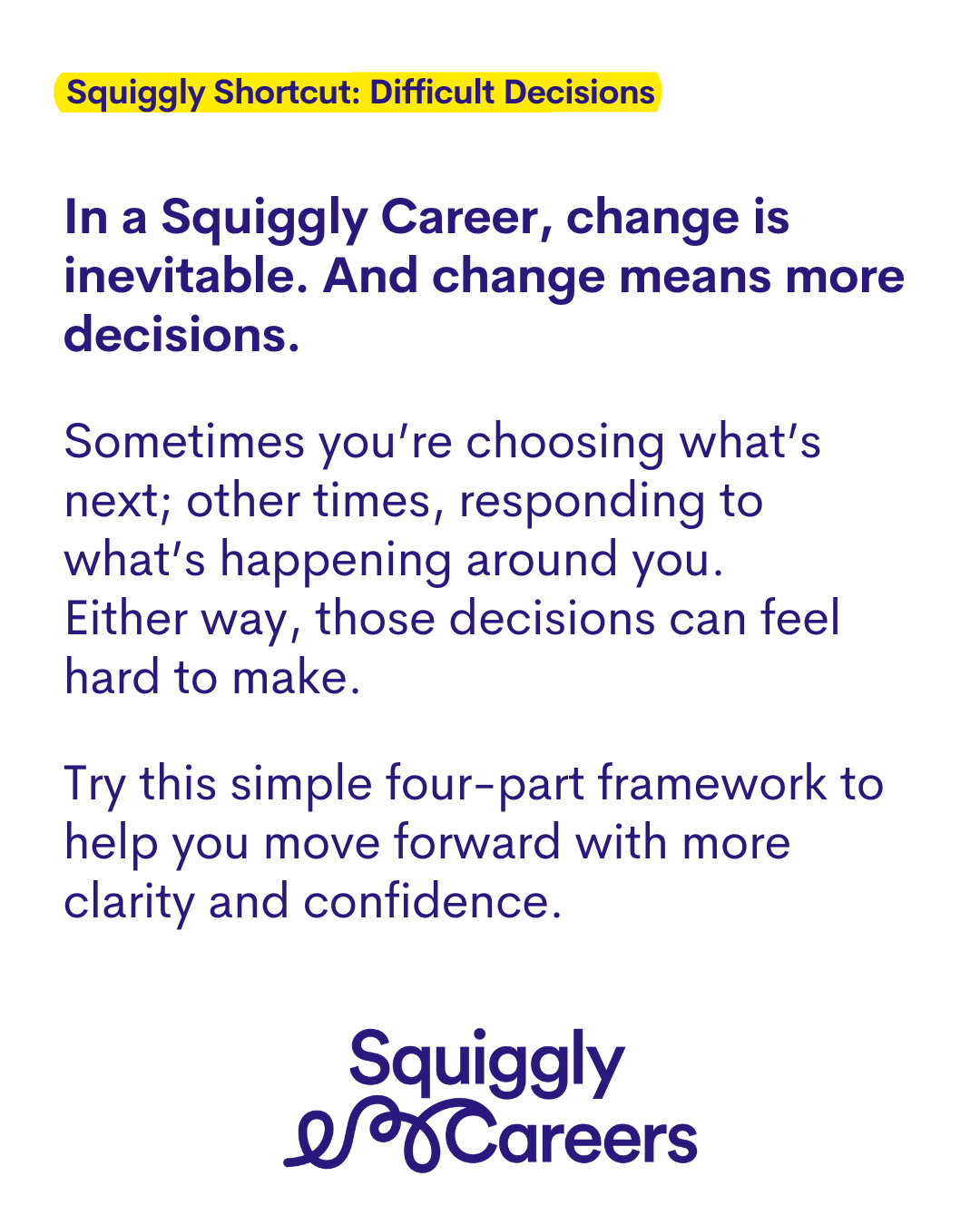
In this shortcut, Helen shares four powerful questions to help you make a difficult career decision. When you’re weighing up your next move, it’s easy to get stuck in overthinking or uncertainty. These questions are designed to help you zoom out, get clear on what matters most, and move forward with confidence.
🎯 What You’ll Learn
– How to make big career choices feel more manageable
– A practical four-step framework for clarity and confidence
– Why connecting with your ‘why’ builds resilience in tough moments
🎧 Listen to Episode 297 to learn more.
For questions about Squiggly Careers or to share feedback, please email: helenandsarah@squigglycareers.com
Need some more squiggly career support?
1. Download our free careers tools
2. Sign up for our Squiggly Careers Skills Sprint X AI.
3. Sign up for Squiggly Careers in Action, a weekly summary of the latest squiggly career tools
4. Pre-order our new book, Learn Like a Lobster.
00:00:00: Introduction
00:00:56: A decision framework...
00:01:03: ... 1: get a bit of distance
00:02:11: ... 2: gather the data
00:03:14: ... 3: move to discussions
00:04:17: ... 4: understand your drivers
00:04:51: Final thoughts
Helen Tupper: Hi, it's Helen from the Squiggly Careers podcast, and you're listening to one of our weekly Squiggly Shortcuts. These episodes are a lot shorter and very focused on ideas for actions. And today, we're going to be talking about when you're faced with making a difficult career decision. Because Squiggly Careers have lots of change in them, it is inevitable that you are going to have more decisions to make about your development. Sometimes that's because of choices that you're making, sometimes it's because of situations you are responding to. But the challenge with making decisions is that sometimes we can doubt ourselves. We don't know what the right thing is to do, we tend to maybe get a bit stuck in a situation, or we outsource the answer to somebody else, "What would you do?" And the problem with that is it's not their career, and I also don't want you to feel stuck in a situation. So, we need to take more ownership. We need a way to work through this difficult decision. And we think the easiest way to do this is to follow a little bit of a framework, and that's what I want to talk to you about now.
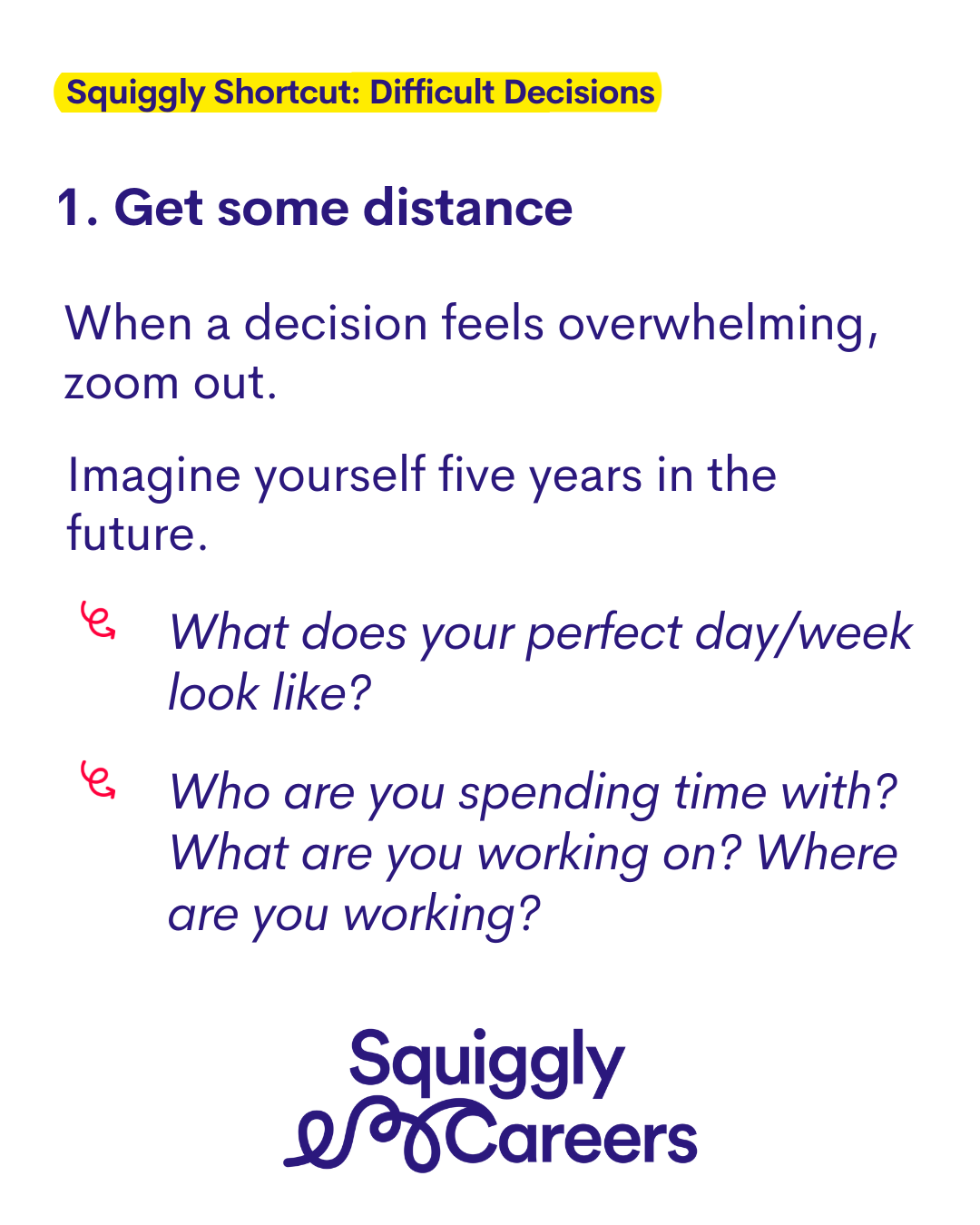
So, the first part of the framework is getting a bit of distance. When you are coping with a difficult career decision, and this might look like deciding whether you should apply for a new role, or it could look like deciding whether you want to change the structure of your working week, or deciding whether you want to leave a company; lots of difficult decisions. The problem with these decisions is they can sometimes feel a bit overwhelming when you're in that moment. And what we need to do is get a little bit of perspective, and distancing can help you to do that. So, imagine yourself five years forward from where you are right now. Think about what your perfect day or week might look like. Who are you spending time with? What are you working on? Where are you working? How do you feel in that moment? And then, what we want to do is connect the decision that you are faced with today with that future version of you. And we're trying to work out which decision will move you closer towards it. So, we're just trying to zoom out from where you are right now to this ideal kind of future state, and see whether that creates any clarity for you.
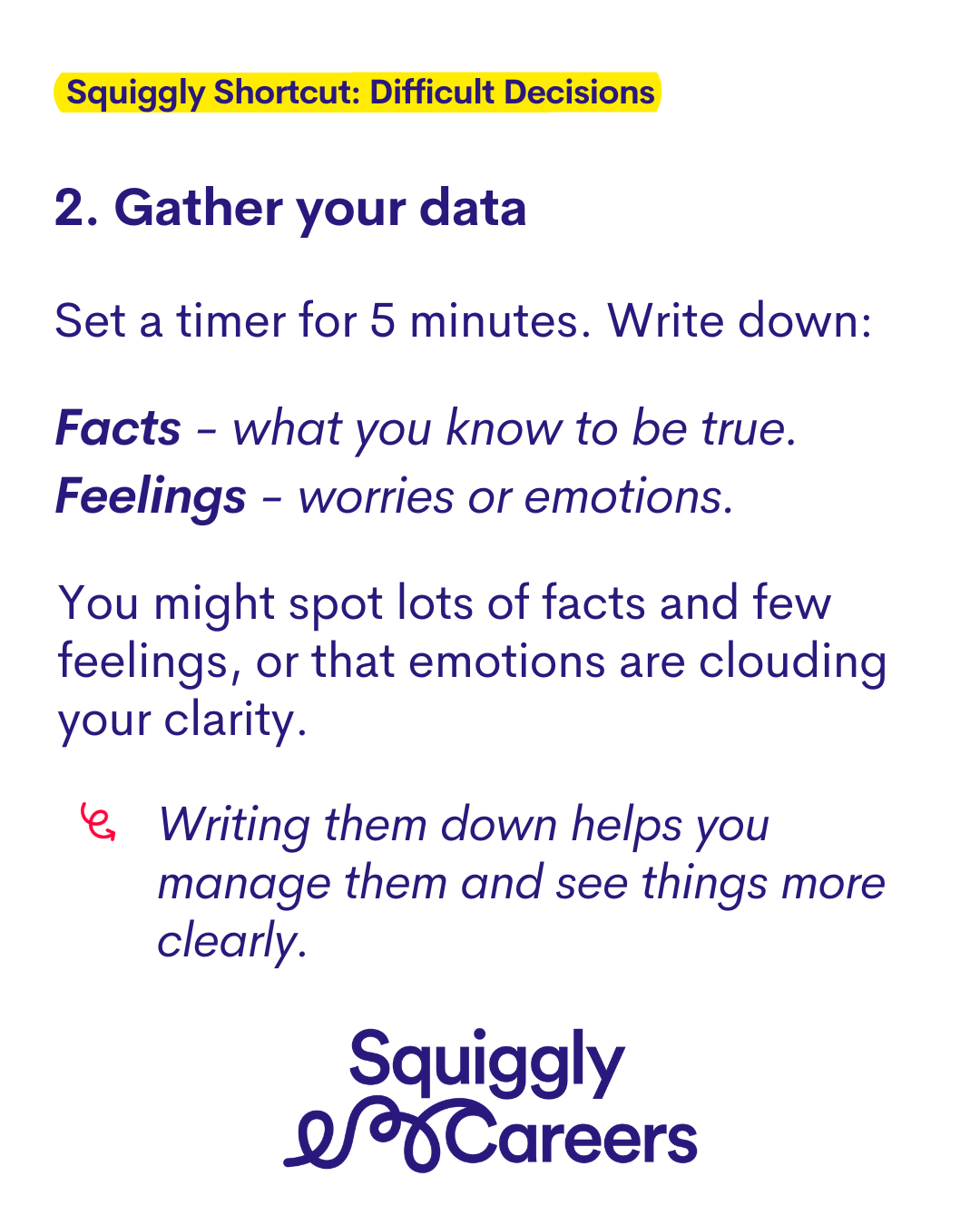
Now, it might help a bit, but there's still more work that we need to do. So, that's where the second part of the framework comes in. This is all about data. So, difficult decisions can feel really emotive, often we're worried about getting it wrong, that can cloud our clarity. We need to get a bit of data. Data is much more objective. So, I would recommend that you set a timer for five minutes. And what you're going to do in those five minutes is take a piece of paper, divide the paper in two, so you've got a left-hand side and a right-hand side. On the left-hand side, you're going to fill it with facts. What are the facts of your current situation, everything that you know to be true? On the right-hand side, you're going to write down your feelings, things you're worried about or your concerns, just the emotions that are currently going around your head. What this helps you to see is whether you've got lots of facts, so you've got lots of detail and actually not many emotions, or maybe whether the emotions are clouding your clarity a little bit. And the psychology on this, which is if you can name the emotion, it is much easier to tame the emotion. So, just the act of writing it down can actually help you to manage it a little bit more.
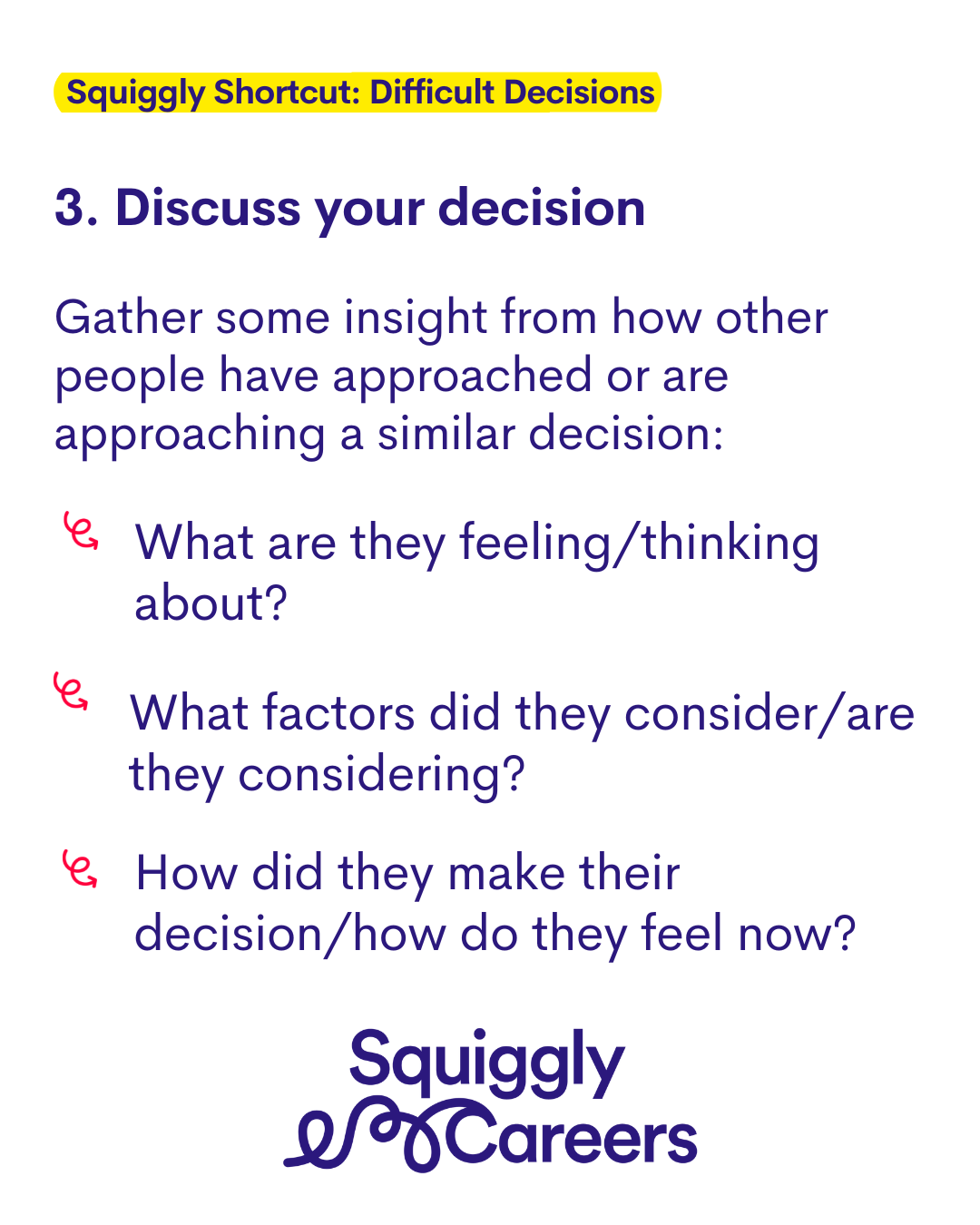
So, we've got distance, we've got data, now we can move into some discussions, and I would recommend that you talk to at least two people about the decision you're trying to make, two people that you can talk to relatively quickly so you're not stuck in this situation. The two people that I'd recommend talking to are somebody who's done it and someone who's doing it; so, someone who has already done the thing that you are thinking about doing, the decision you're thinking about making, and somebody who's likely to be in the same situation at the moment. Now we're not asking them, what would you do, what do you think I should do, because that's just outsourcing the answer to them. We're not doing that. The person that's done it, ask them, "What was your thought process? How did you go about making that decision? How do you reflect on it now?" The person that's doing it, ask them, "How are you feeling? What are you considering? What factors are you thinking about?" Just get a bit more insight from how other people have approached or are approaching this situation.
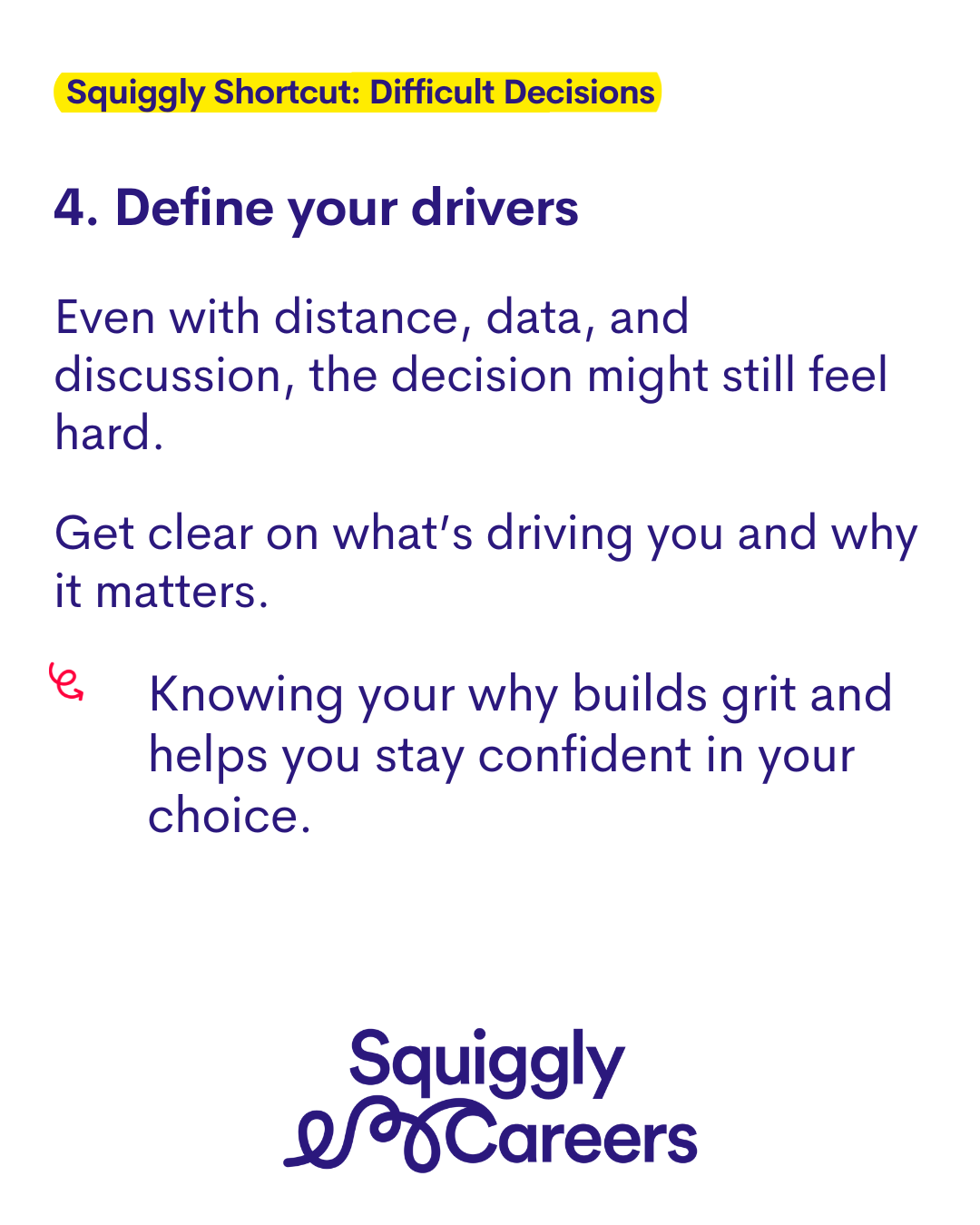
Then you've got to make the decision, okay, you've got to decide what you're going to do. But this comes to the last part of the framework, which is all about your drivers. This decision will still be difficult. Even with distancing, even with data, even with discussing, it's still going to be difficult. So, I want you to really think about what is driving you. Understanding the why behind what you are trying to do will grow your grit. So, it might still feel like a hard decision to make, and even when you've made it, it might not feel that easy with whatever outcome you get to, so you want to feel that you're connected to your grit. And knowing the why behind what you want to do will help you to do that.
So, I hope that's given you a bit of a framework to follow if you are faced with a difficult decision right now. If you want to listen and learn more, we've got a full episode on this. It's episode 297 of the Squiggly Careers podcast. We'll put a link in the show notes. And if you've got feedback, you can send it to us, helenandsarah@squigglycareers.com.
Sign up to the Squiggly Careers Newsletter and get our latest ideas, tools and inspiration every week - all in one place, straight to your inbox


