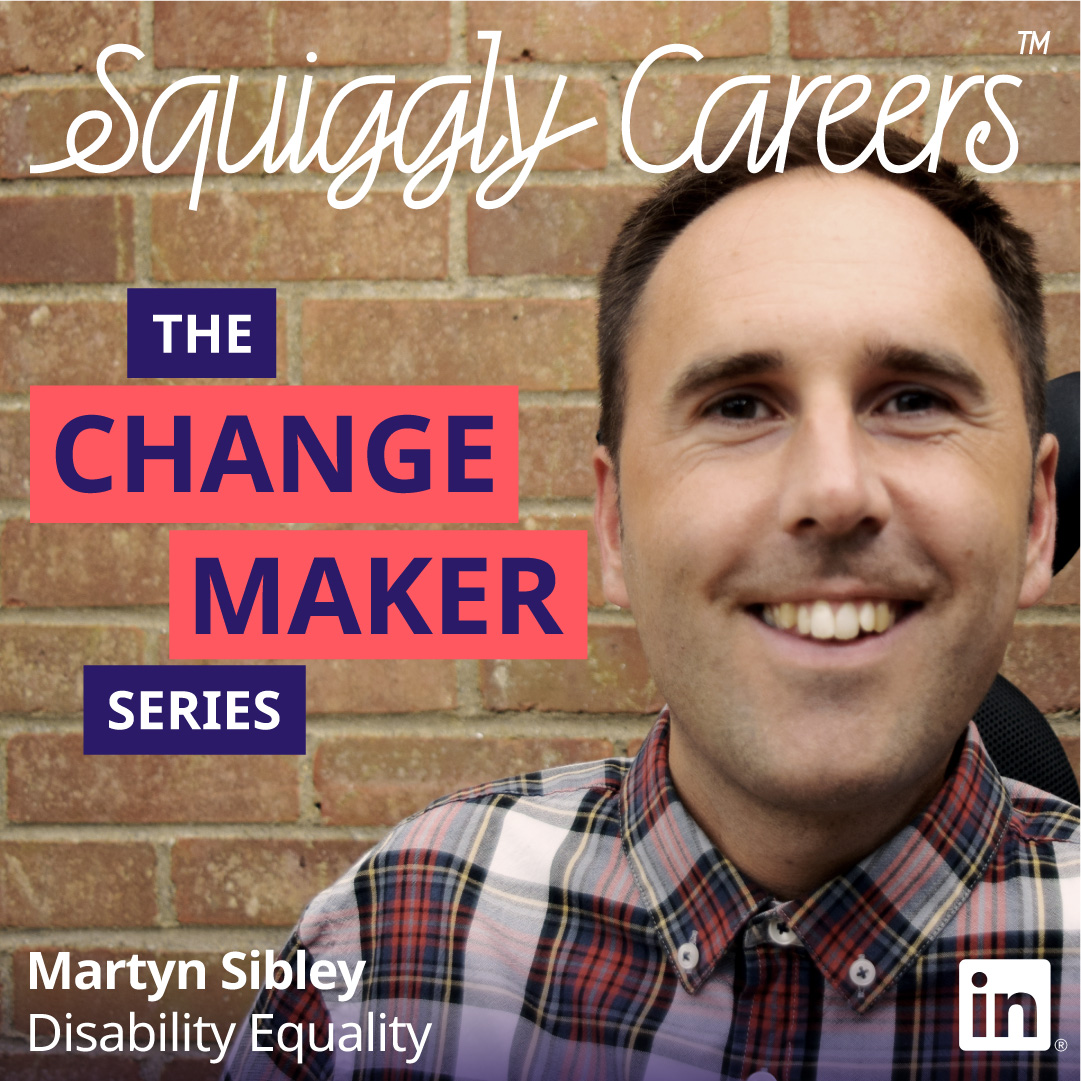
In this special episode of the Squiggly Careers x Changemakers podcast Helen talks to Martyn Sibley who is leading change in disability equality. Martyn is co-founder of Purple Goat agency and his goal is to help companies connect with the needs of the disability community to transform the way everyone lives, works and contributes.
Martyn describes himself as ‘a regular guy who happens to have a disability.’ Together Helen and Martyn talk about what helped him to create change as well as what has helped him through the hard times. Martyn also shares his role models and how we can all get involved and support the work he is leading.
This podcast was created with support from LinkedIn and their changemaker campaign.
If you’d like to find out more about the LinkedIn changemaker campaign visit: https://blog.linkedin.com/changemakers-uk
You can follow and connect with Martyn on LinkedIn to find out more about his work: https://www.linkedin.com/in/martyn-sibley-1227b411/
00:00:00: Introduction
00:01:39: Disability inclusion
00:02:03: Inspiration and motivation for change
00:06:29: Negativity and positivity surrounding disability
00:08:11: Signal of success
00:09:43: Optimism for the future
00:11:19: Role models
00:13:00: How to get involved
00:15:32: Career advice
00:16:43: Final thoughts
Helen Tupper: Hi, I'm Helen Tupper and this is a Squiggly Careers podcast, and today's episode is one of a special series of short conversations that we've had with this year's LinkedIn Changemakers, which we are also very proud to be included in. Each of the people is pioneering change in the world of work. They're making an important difference in areas including equality, mental health and sustainability, and we're really looking forward to learning more about how they're all making that change happen and their hopes for the future and probably, even more importantly, how we can all get involved to support their work.
So today, you're going to hear my conversation with Martyn Sibley. Martyn is the Co-founder and CEO of the Purple Goat agency. They're a specialist disability and inclusion marketing agency, and Martyn is one of the most influential disabled people in the UK. He's helping LinkedIn members and companies connect with the needs of the disabled community to transform the way everyone lives, works and contributes.
I loved this conversation with Martyn, because he's really positive to talk to, I got a lot of energy from our discussion, and he's practical and pragmatic. So, I learned and I was inspired, and I could have listened to him even longer than this episode that we put together. But thankfully, I'm going to put all of the links that you can follow, all of his work beyond this conversation, in the show notes too. So, let's get started.
Martyn, welcome to the Squiggly Careers podcast.
Martyn Sibley: Hello, Helen, good to be here.
Helen Tupper: I'm so excited to talk to you and about your change. So, maybe we'll start there. What is the change that you are passionate about?
Martyn Sibley: So, within the LinkedIn context, a punchy line, if you like, is around having more disabled people in leadership roles. And I would say that there has been a broader mission through my life and career around disability inclusion in general. I've got a disability myself, I'm a wheelchair user, and it's just a real passion to drive change and have more inclusion of disabled people in the world.
Helen Tupper: And, what was the point at which you realised that you wanted to be a really active changemaker, so it was something that you were passionate about, something that you'd personally experienced, and I guess was there this tipping point when you were, "This is what I want to stand for"?
Martyn Sibley: Yeah, great question, because particularly in the disability world, I don't know if it transfers into some of the other diversity and inclusion strands, but a lot of the activists with disabilities I know, we've always had this early part of resisting going into that world. It's almost like, "Okay, if you're disabled, a job in disability's a bit obvious or a bit clichéd", and I'm talking when I was a teenager and going to uni.
So, at that period, I did an economics degree, a Master's in marketing and was really just looking to go down that generic route in terms of finance and that world. I enjoyed it and I loved it; it was a positive, not a kind of blind zombie dream, but yeah, I enjoyed it as well. But I think because of my lived experience of disability, the sort of things I have to juggle around looking after, when I get different energy levels in the winter, on more of a health level, around independent living: I need funding for wheelchairs and the care team that support me with the everyday tasks I need help with; and also, the barriers in society, getting into buildings and transport, those sorts of barriers; also the attitudes and the policies as well that disable people.
As I got my head more my head round that social impact side of disability, and also the numbers; there are 1.3 billion people in the world that are said to have a disability, so I went through this process of actually, there are a lot of things that I think should be better for me. But also, this is affecting a lot of other people beyond just myself. And I guess it was around after uni, I got a job in a charity, a disability charity, and all these things started to fall into place in my mind.
I was like, well actually, I could still use the economics and the marketing as part of this change. I got that fire in my belly to make a change in that way, and that's now around 15 years ago. So, it's been 15 years career-wise very much about this topic.
Helen Tupper: Listening to you, I'm struck by the size of the challenge and the change; 1.3 billion is a big number! I didn't study economics, and I know that that is a big number! And, your own experiences of society. You talk about winter and your own life. It sounds really hard and you've sustained that fire in your belly for 15 years, if not longer, because that was probably the point at which you were like, "Right, I'm going after this". Where does that energy come from, what keeps the fire in the belly going?
Martyn Sibley: I think there's talk about sticks and carrots and life, and I think one of the sticks, in terms of trying to get the world to be more inclusive around disability is the injustice, and you look at poverty and the high unemployment levels. So, I think there's partly a motivation of righting the wrongs that are going on in the world for disabled people.
But then, the carrot side of it for society is as a business case around it. The 1.3 billion people are consumers and so, if you're a business, and that's more where I'm at now as a day job, so to speak, is running a marketing agency that helps brands to connect with disabled consumers, and I think that carrot is a really big carrot for the businesses. So for me, I think it's learning about the different ways to engage society, different ways to educate society. As you say, it's a big task, so there's always different things every day that I get to work on, different kinds of projects. I think variety is the spice of life, as they say.
And I think it is partly knowing when to switch off. There's been a lot of personal development and self-awareness of when I need a bit of time out from it and a bit of a holiday, but then also to get stuck back in with those new ideas and those new projects that keep that fire burning at the same time.
Helen Tupper: Has there ever been, as you approached this change that you're looking to make in the world, is there anything that you've learned that's surprised you, challenged any of your assumptions or expectations you had about it?
Martyn Sibley: Yeah, definitely lots of surprises across the board. I suppose, when you look back at the kind of history of disability rights, now there's a lot more of a business conversation. But originally, it was a very political human right conversation. Obviously, that's still going on in many parts around the change we're trying to make, but it's shifted into there are now laws, like the Equalities Act and the Human Rights Convention and all those sorts of things around disability that were really hard to fight and win in the 1970s and 1980s.
So, I think that there's a surprise at the exclusion and the injustice that many disabled people face. There's a surprise how slow it seems to take for change and like I said earlier, I think there's a lot of similarities with other D&I strands, like race and gender and sexuality. Everyone sees that there's a problem and it's like, "Why can't we just solve this now?"
But I think positive surprises are around that, for all of those difficulties and injustices, it's not that very many people set out to do that to disabled people, it's often around lack of awareness and lack of education. So, when you actually start to engage both everyday people and brands, now I'm working with CEOs at tier 1 brands, they really want to make a difference, a positive change. So, I think there are negative surprises and positive surprises as well.
Helen Tupper: And, appreciating that point that this change is hard and it has perhaps been slower than we would want it to be, with the work that you've been doing is there something that you're particular proud of over the last 12 months which is like a signal, like a success signal of the impact that you're having through what you're doing?
Martyn Sibley: Well, the obvious one that's brought us together to know each other, Helen, is the LinkedIn Changemakers that we're involved in. So, I've been blogging since 2009, so a lot of my work has been around content creation and building community, and then the impact with bigger institutions. And there's lots of time you're just plodding on and you and I, we're in it really for the awards and the accolades, it's because we really love and believe in what we do.
So, yeah, when a brand like LinkedIn says, "Do you want to come and be one of our Changemakers and do a TV ad?" it would be silly to pretend that doesn't stroke the ego a little bit! But also, it's a nice signal that the work I've done has been recognised and it's an amazing opportunity to scale up what I'm doing; I say "I", I've got lots of allies and colleagues in the disability world. I think it's going to help the whole community get a lot more eyeballs as well.
Helen Tupper: I agree, I think it's brilliant for the work to be recognised by an organisation and a platform liked LinkedIn, and then to reach more people through it, it's really, really exciting. So, beyond this year then, how optimistic and positive do you feel about this change for the future?
Martyn Sibley: I mean, I'm generally a very positive, optimistic person, so drilling it down to a couple of everyday things I face, I've gone on holidays, I've vetted it, researched "accessibility", arrived and I can't get in the hotel, or I can't use the shower. Really, those are what should be really basic things that still aren't quite right.
So, it would be very easy to get more on the frustration and pessimism of, we're still having these same conversations we were having 20, 30 years ago; but I think actually, when you look over decades and generations, historically there is a lot of progress and a lot of positive change, so I think it's only fair to extrapolate that in the future, that we will still see those longer-term improvements.
I think the other reason for optimism is looking at, I'm now in my late-30s, so I'm starting to not be called a young activist or a young changemaker anymore! But seeing those other people coming up in their 20s with disabilities that are banging the drum and using the new tools that are out there around social media, TikTok and how they're using TikTok for social changes, is really exciting as well. So, yeah, I'm definitely optimistic that we're on the right path, but I think there's a bit of patience you have to parry with that as well.
Helen Tupper: And, I imagine that for some of those people that you mentioned, some of the younger activists or new activists, you're a role model for them because of what you're achieving and what you've been doing; and I wondered, who's a role model for you, who inspires you?
Martyn Sibley: Yeah, great question. It's always that I can never give one. I always go into business-wise, I've always found Branson's use of branding and entrepreneurship, and I know as anyone gets that big and rich and famous, they tend to find themselves on the negative side of press stories as well, but generally reading his book was a big role model for my entrepreneurial pursuits.
Obama, Gandhi, Luther King, Mandela are really big role models around the social change stuff. And then with disabilities, Tanni Grey-Thompson and Jane Campbell have become really big political activists, but done amazing stuff; obviously, Tanni in the Paralympics previously as well. But it's a really important point you make around that, that when I was growing up, there were very few disabled role models; but because of social media, there are role models across all walks of life, again not just disability, but all the other D&I strands. I think that's massively empowering.
Something else I'm really proud of was I was voted Britain's third most influential disabled person in the Power 100 list, and that Disability Power 100 list is all about getting role models out there for that younger generation to aspire to be like, obviously in their own Squiggly path as well! But yeah, I think role models are massively important.
Helen Tupper: So, if people were listening, if there was one thing that they could do that you would think, "Well, this supports my work, this is something that I would love to encourage people to do", what would that be?
Martyn Sibley: I suppose, obviously in my industry now, there's that obvious side around brands and brands being more representative of disabled people. So, first and foremost, anyone in that world, just get in touch and it would be great to talk a bit more about the work we do at Purple Goat, working with disabled influencers and marketing.
But I think if it's someone not as directly in that industry, I think it is first of all that awareness, just being aware of some of the things we've discussed today, Helen, about the numbers and the impact around disability. The knowledge is really important, that people are more aware of it. And then I think after that, stuff will just come up, depending on what people's jobs are, or when they're out and about in the street, I just think have that more sensitivity and compassion that disability isn't a pity party, it's not all about welfare and rights, which partly there is that narrative; but actually, there's a more middle of the road narrative that disabled people work and have relationships and go on holiday.
I think the most powerful thing is to see disability in that more modern "normalised" way. I think that's really where a lot of change will just come as a consequence of changing stereotypes really.
Helen Tupper: Yeah, I agree. Where can people go to find out either more about Purple Goat, or more about the work that you're doing as a Changemaker for LinkedIn?
Martyn Sibley: Yeah, so obviously the LinkedIn stuff, there's going to be a lot happening around articles, so I definitely for that reason would tell anyone on LinkedIn to connect with me there. And even in the lead-up to us doing the Changemaker programme, I've found LinkedIn really powerful for getting the interesting articles and posts out there that are finding people that were not engaging with this topic previously. Obviously, on the business development side, it's extremely powerful as well. So, yeah, I think LinkedIn is the obvious place to go.
Then, purplegoatagency.com has got what we're here to do and what our services are. And I've got my own website, martynsibley.com, but I've shifted the blogging from there a bit more to the social media platform. So, I'd say Instagram and LinkedIn are the best places.
Helen Tupper: Well, we'll put all the links to everything Martyn's just mentioned in the description, so you'll be easily able to find it. And I have one last big question for you. We've covered some big things in this conversation, but the last question is your best piece of career advice for our listeners?
Martyn Sibley: Yeah, I love that trying to pass on the experience. I do want to come back to what we both said around the fact it will be Squiggly and everyone's journey is their own. So I think it's, take that inspiration that we're talking about role models, tap into yourself about what your personal passions and dreams are, but really it's to enjoy the journey and just take your time with it.
I keep using that word "patience" a lot as well, so it's not one finite thing, but it's probably just around that. Set the goals, all the general stuff we talk about in careers advice, but most of all it is to be flexible and enjoy the journey and not be too stressed about always reaching the destination so quickly.
Helen Tupper: Thank you so much for listening to today's special episode of the Squiggly Careers Changemakers podcast, and if you would like to know more about Martyn's work, you can find all the links in our show notes. And don't forget that we've got lots of other short conversations with LinkedIn Changemakers, including Layla Acaroglu, sharing her work on sustainability, and also Andrew Macaskill, who I had a conversation with talking about job search, and how do we end job search misery? So, that was a really enlightening and insightful conversation as well.
But we will be back again with you very soon and I shall say bye for now. Thanks everyone.
Sign up to the Squiggly Careers Newsletter and get our latest ideas, tools and inspiration every week - all in one place, straight to your inbox


