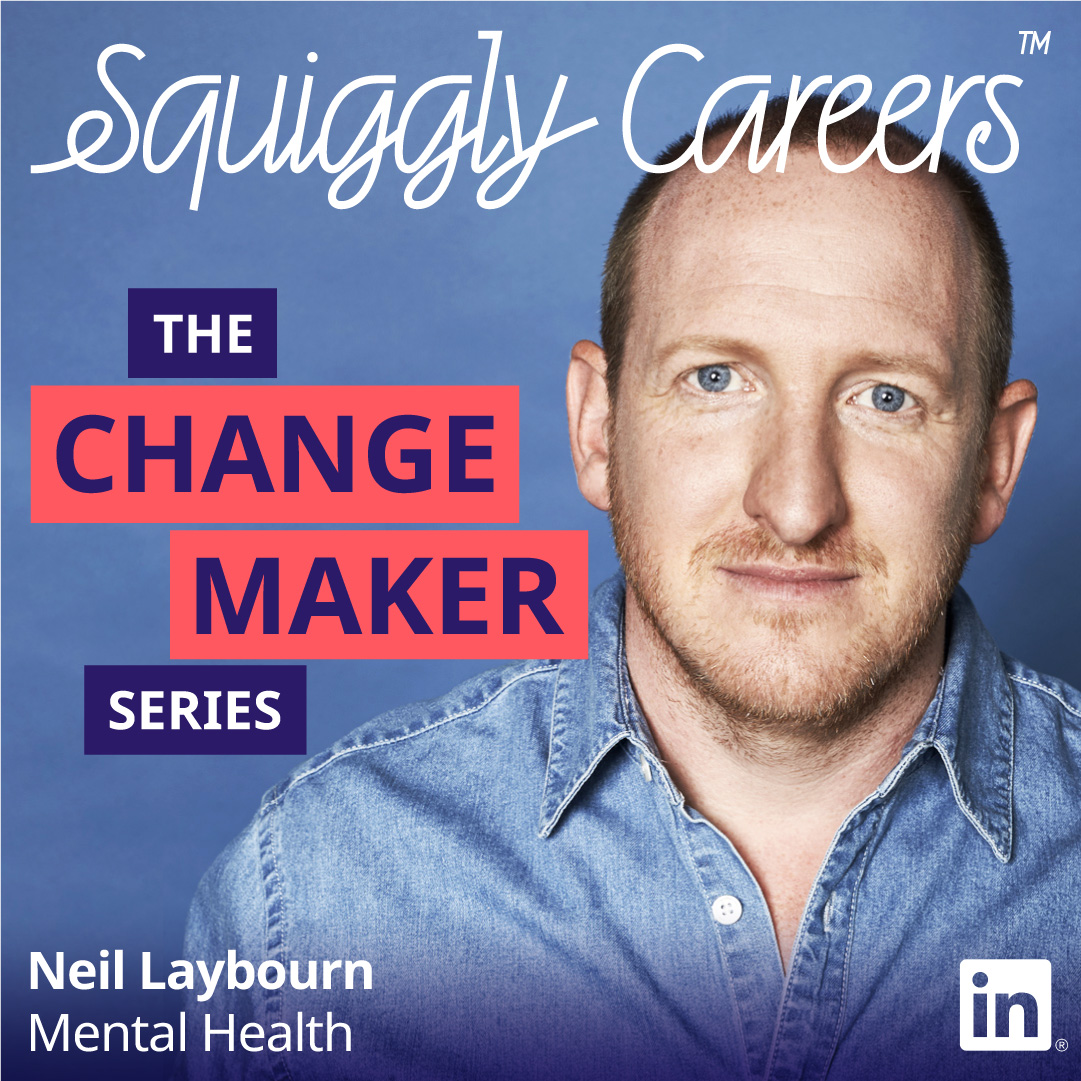
In this special episode of the Squiggly Careers x Changemakers podcast, Sarah talks to Neil Laybourn who is leading change in mental health. Neil co-founded the charity Beyond Shame, Beyond Stigma, a mental health charity supporting young people. Neil is also an ambassador for Mental Health UK. Together Sarah and Neil talk about the pivotal moment that proved to be a catalyst for Neil’s passion and commitment to mental health and where his work has led him over the past few years. Neil shares what has helped him to create change, as well as what has helped him through the hard times.
This podcast was created with support from LinkedIn and their changemaker campaign. If you’d like to find out more about the LinkedIn changemaker campaign visit: https://blog.linkedin.com/changemakers-uk
You can follow and connect with Neil on LinkedIn https://www.linkedin.com/in/neillaybourn/ and learn more on his website: https://neillaybourn.com/about-us/about-neil/
Information on Mad World Summit: https://www.madworldsummit.com/
00:00:00: Introduction
00:01:32: Neil's background
00:03:59: Mental health initiatives
00:06:25: Intervention conversation
00:08:50: The language of wellbeing
00:12:15: Career advice
00:13:54: Final thoughts
Sarah Ellis: Hello, I'm Sarah Ellis and this is the Squiggly Careers podcast. This episode is one of a special series of short conversations we've had with this year's LinkedIn Changemakers, which we're also very proud to be part of. Each of the people that we're interviewing is pioneering such important change in the world of work, whether it's making a difference in areas like the quality, mental health and sustainability. We're really looking forward to learning more about how they've made that change happen, their hopes for the future and how we can all get involved.
Today, you'll be hearing my conversation with Neil Laybourn. Neil is championing change in mental health, and as you'll hear in our chat together, it was an unexpected moment in his day and then his year that ignited his passion and work in mental health. I hope you enjoy listening to our conversation today, and I'll be back at the end to let you know how you can learn more, and who else you can hear from in this really special series.
So, Neil, really good to meet you and thank you for joining us on today's special episode of the Squiggly Careers podcast.
Neil Laybourn: Thank you, happy to be here.
Sarah Ellis: So, I'm really looking forward to learning a bit more about the work that you do, and I thought let's start with you sharing with our listeners the change that you really want to champion through the work that you do, so everyone gets a real feel for the important thing that you're trying to pioneer. So, I'd love to get your take on that change.
Neil Laybourn: Sure. Well, my career has been very varied since I first stepped into the working world and present day, it involves me predominantly being within mental health and wellbeing, absolutely by accident. It happened very organically. It started with one pivotal moment when, in 2008, I was actually on my way to the gym and it was going to be a normal day, as far as I knew. I walked past a guy who was sitting on Waterloo Bridge; his name was Jonny Benjamin. He's very well-known now; at the time, he was about to take his life.
I'm going to be very, very brief here, so I hope I don't this an injustice to anybody that's listening and has an affinity to this subject, but essentially we spoke on the bridge as strangers, it was a very spur-of-the-moment thing for me instigating that, and I had no idea that it was going to impact my transition into the career of mental health that I'm in today. So essentially, yeah, I'm talking to this guy on Waterloo Bridge and we've connected, but the police ended up getting involved and taking Jonny away, and my day and life just continued as normal, thinking that would just be this one random act.
Then, in 2014, that random act just came out of the blue back into my life again when that guy, Jonny, unbeknownst to me, had had this amazing recovery period in his life, had become a mental health ambassador, was trying to create awareness around men's mental health, around suicide prevention, and reached out to essentially find that stranger who spoke to him on the bridge. At this time in 2014, I was still a personal trainer, I was running retreats and bootcamps and still training people in Covent Garden, and it was just this wonderful moment that I leaned into something that I didn't know about, through meeting Jonny for the second time.
When I met him for the second time, we became friends, and the press picked this story up, and it enabled me to learn more about what is mental health, what is suicide, what is schizophrenia, the diagnosis that Jonny had. And I started doing ambassador work for a mental health charity as we were developing our friendship.
Somewhere along the line, I ended up being more involved with working alongside any mental health initiatives than I was doing anything with physical health. I'd always worked for myself, I'd always run my own company, so there came a point where it just seemed to make sense to maybe transition into something that seemed a bit more destined for me to do, because by this point, organisations, companies were looking more at mental health and as I said, our story was in the public sphere. We were working with other people to create awareness around mental health, and I find myself in present day going into a lot of organisations.
I use that term, because it could be companies, it could be schools, charities, prisons, anywhere, trying to open up conversations around mental health and wellbeing, then hopefully developing relationships with those organisations to keep enabling their growth, their understanding; and at some point, those relationship fall off and drop off, because we've just reached a natural break in how we're working together, and we're always developing new ones all the time.
It's exciting. I've met thousands of inspirational people over the years. Hopefully, that journey just continues. But what I tend to do, if I was to define what I do day to day, it's really around getting people in a room, sharing ideas, creating platforms where there's peer-to-peer access around understanding what somebody else is doing in one industry, how they could apply it in another industry, or just getting ideas really.
Sarah Ellis: So, when you were sitting or standing next to Jonny on that bridge that day, how did you figure out what to say? Did you really think about what you were going to say, or did you just have a chat as you would do with anyone else?
Neil Laybourn: I think the magic of the moment on the bridge really, and let me just -- I think it's really important for anybody listening, around this context of suicide and both sides, for the people struggling and for the people who would want to help, is that people are helping all the time; interventions are happening all the time. Our story, or my story in this, there are so many untold ones, so it's not anything spectacular. People can help people all the time, and we were just lucky that ours got picked up and we could do something with it.
But I think, to answer your question about, what was it about that conversation that was unique, I think the fact that nobody was listening, nobody was watching. I felt like, in that really rare, extreme circumstance where you feel like, okay, this is a few seconds or a few moments or minutes in my life that's going to mean something, if you can just be yourself with that and just trust your instinct, that can go a huge way. That's really difficult to do when we're in discussions like interviews or podcasts. I know there are going to be people listening to this, and that might subconsciously affect how I talk and what I talk about.
But on the bridge then, and in many other times in our lives, when nobody's watching and you just be yourself, I feel there's this extra part of you that is sometimes hidden away that people don't get to see all the time. And I think that was it. I think I was genuinely just trying to be honest with Jonny; I think I was just trying to really connect with him; and I think just being myself and not worrying about the outcome of what I said, I wasn't going to be judged on it. Nobody else could hear what we were talking about on the street, and that's really, really powerful.
It's not easy to apply that to everyday life, because usually people do know everything we're talking about now, so I think that was it. I think it was just finding times when you can not be watched really helps you to be your best self, if that helps. So, I think being instinctive, I think, and not trying to follow a script; and I didn't have one back then. I was literally just trying to make a difference in that moment.
Sarah Ellis: I think now, we're in quite a different place with mental health than we were four or five years ago. I'm not even sure we would have had this conversation four or five years ago. So, there has certainly been, as you said, a lot of press about it as an area of focus, much more increased awareness about importance, but it's still interesting to know, what are those things that you keep thinking, "What if I could wave a magic wand to make a difference on an area?" or some areas that still feel quite hard, or we've just not got the answers to yet, because these are big challenges, these are not things that are going to get solved or fixed overnight. What are those things that you see quite frequently, almost regardless of industry or organisation?
Neil Laybourn: Well, I think people very often haven't had the opportunity to explore the breadth of their own wellbeing, their own mental health, their own emotions. I mean, it's a language, isn't it? If you're excelling at a career, you should be able to speak that language really, really well. I think a lot of organisations have realised, "We need to put people in place to discuss wellbeing", whether it goes to HR or whether it goes to a wellbeing lead, or somebody else. I wonder how much that person actually knows this language of wellbeing themselves, and I'll give you an insight on qualification.
So, yeah, I've done training courses around this, and I think it's important to do that, even though I've had lots and lots of exposure. But the real qualifying factor is just listening and being privy to so many conversations; and through those, letting myself talk about me helps me to find my own language with wellbeing that feels comfortable for me as an individual. I think, if organisations could give people time to do that, and you've got to showcase that, I think; you've got to show people what it looks like to talk about wellbeing. That's why there's so much storytelling in companies. And, I just think it comes down to the people who are given this role to encourage conversations.
What's really helped me, I think, to bring this conversation to people is that I was doing charity ambassador work for a few years before I stepped into any companies, and a lot of that was speaking to people with ill mental health, not necessarily speaking to people around their general wellbeing. So, I had lots of experience having all the tricky conversations around things like suicidality or depression, or people really disclosing things, and figuring out how I would react to that. So, yeah, when it comes to having the conversation about general wellbeing, it's a much broader landscape.
I think it's about confidence, and if people can be invested in, so not just maybe as like an add-on part of their role. The thing is, I think people want to help, I think people generally understand that many of the people in their workplaces are struggling and they want to be that ally, that want to be that support system; but you do really have to go through a journey of exploring the language first, because it can be triggering.
I certainly found it difficult in the first couple of years, because as everybody on the planet, we've all had things that go on in our head that make us feel scared, we've all had bad days, I think we've all had dark days, I mean I certainly have. It gets easier; it gets a lot, lot easier to just be exposed to the conversation of mental health.
I think there are also a lot of people in companies maybe that want to help people, but they realise it is difficult to even listen to somebody else's mental health struggles, therefore they can't be part of the conversation. It needs to be a very consultative approach about the right people, and I think companies need to go through a bit of a journey to let those people just put their hand up and say, "I want to be the one to do that", rather than saying, "You should be the one, because you lead the team. You should be the one because you look after 50 people".
Sarah Ellis: And then, the last question to finish with, and we ask all of our guests on the podcast this, whatever they're talking about, but I'm always interested to know if you've got a best piece of career advice that you'd like to share with our listeners, either your own advice that you'd just like to share your words of wisdom, or maybe something that someone has said to you, or something that you've read that you've just always found helpful.
Neil Laybourn: Okay. Somebody said it to me once, and it's just the way they said it and how they said it, and I'm sure many people have heard this before. It was when I was working with a labourer and I was just having a chat with my boss who ran the company, and it was just the way he looked in my eyes and said it deadpan. He said, "Look, if you're not happy about anything in your life, just change it; nobody's going to do it for you".
Somebody else said to me, "Just do what makes you happy". I had this friend, I guess, and he was very successful in his career, used to mentor with me, and we sat down and he just started with, "Right, write 1-2-3 on a piece of paper and just write the top three things that are most important to you in your life", and just a simple thing like that helped me to think for the first time, "I think that's what's most important for me". And, go out and engineer it for yourself; you'll thank yourself in the future.
My last thing I just want to say is, nothing is worth sacrificing a good night's sleep for, no target, no comp package, no expectation. If you can't get yourself a good night's sleep, you're no use to anybody and you should tell the other person at the end if they're disruptive.
Sarah Ellis: Thank you for listening to today's special episode of the Squiggly Careers Changemakers podcast. If you'd like to learn more about the work that Neil Laybourn is doing, you can find links in our show notes. And don't forget, you can also listen to other short conversations with LinkedIn Changemakers, including Dr Leyla Acaroglu, who shares her work on sustainability, and Martyn Sibley, who discusses disability equality.
So, we're back with you again soon. Thank you so much for listening and bye for now.
Sign up to the Squiggly Careers Newsletter and get our latest ideas, tools and inspiration every week - all in one place, straight to your inbox


