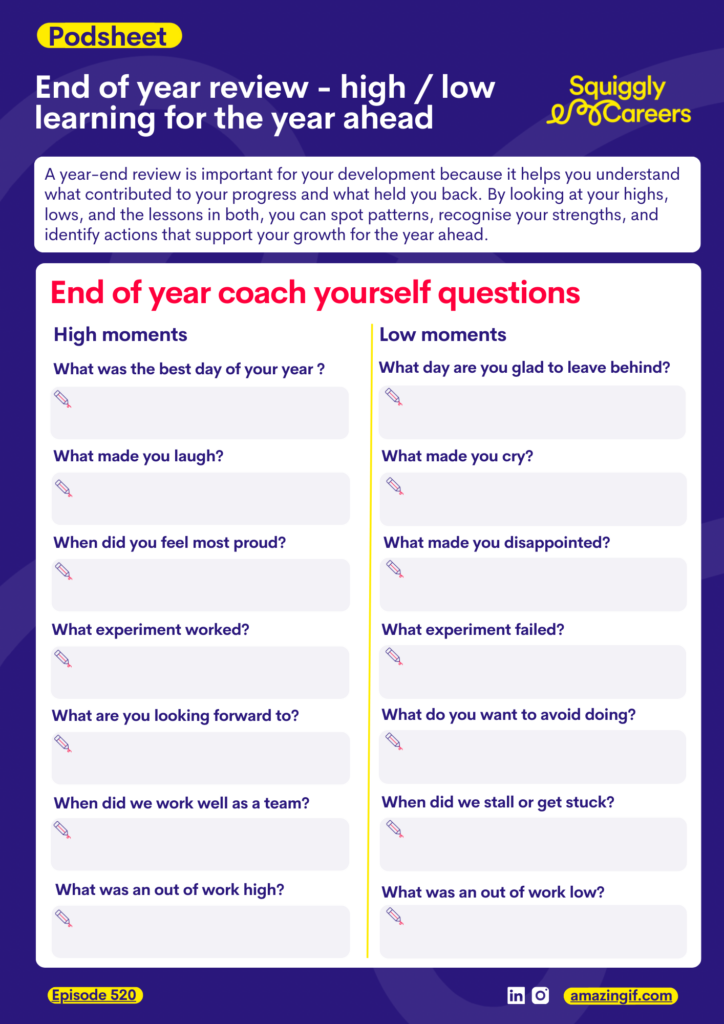

In this episode, Helen and Sarah do something they’ve made a tradition at Squiggly Careers: a year in review. This year they’re sharing honest reflections using a simple but powerful framework: high–low learning.
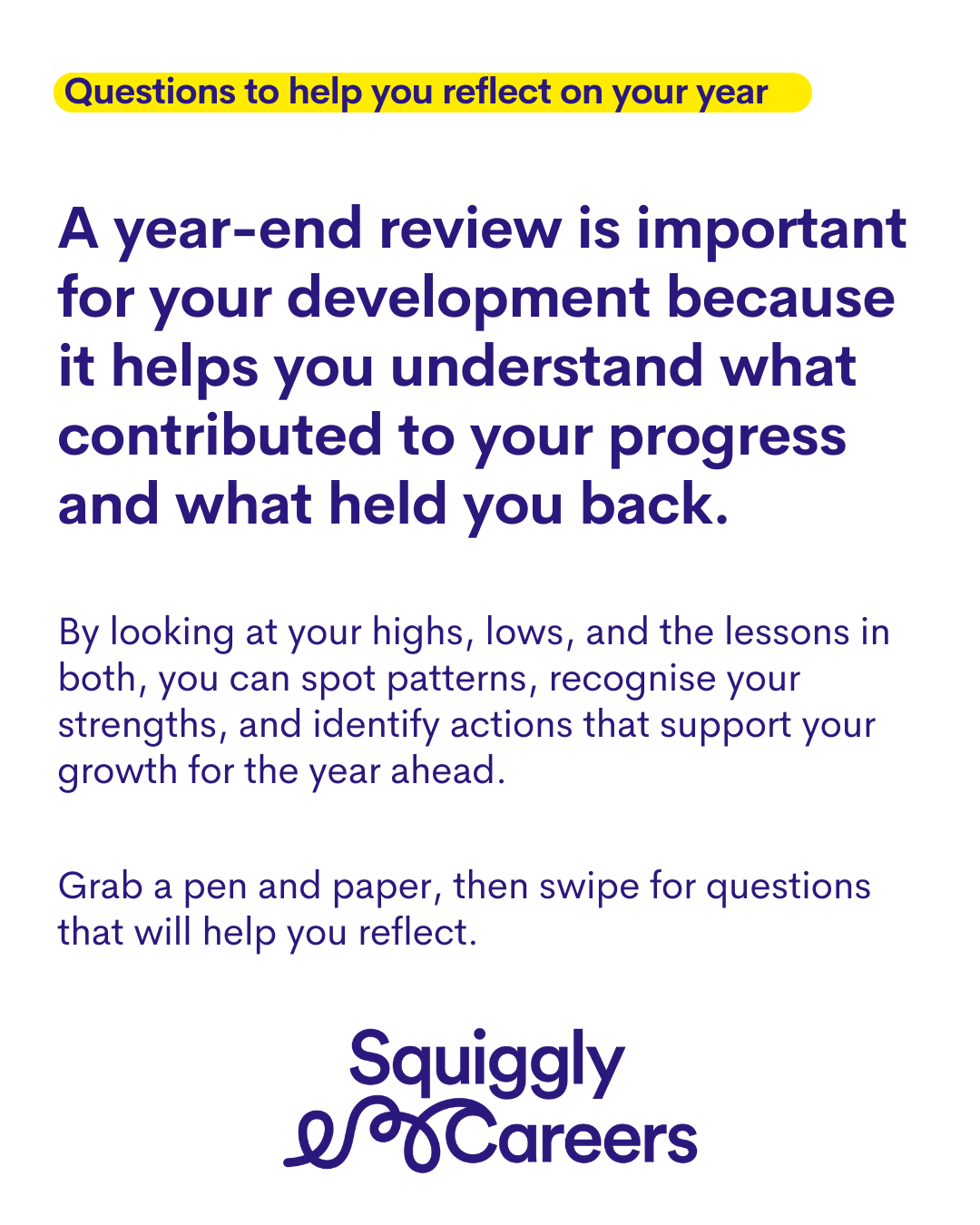
This behind-the-scenes episode is designed to help you reflect too. Whether you do this solo, with a learning buddy or as a team, the questions Helen and Sarah use can help you turn reflection into insight – and insight into action.
🎯 What You’ll Learn
– How to use high–low learning to reflect on your year
– Why experimentation matters (even when it doesn’t work)
– How to spot recurring frustrations — and do something about them
– Questions to help you close the year with clarity and intention
For questions about Squiggly Careers or to share feedback, please email: helenandsarah@squigglycareers.com
Need some more squiggly career support?
1. Download our free careers tools
2. Sign up for our Squiggly Careers Learn Like a Lobster Skills Sprint
3. Sign up for Squiggly Careers in Action, a weekly summary of the latest squiggly career tools
4. Pre-order our new book Learn Like a Lobster

00:00 End of Year Review
02:51 High–low learning explained
03:59 Best day vs the worst day of the year
14:03 Experiments that worked (and didn’t
28:06 Life outside of work: highs & lows
38:43 Highs you're anticipating & lows to avoid in 2026
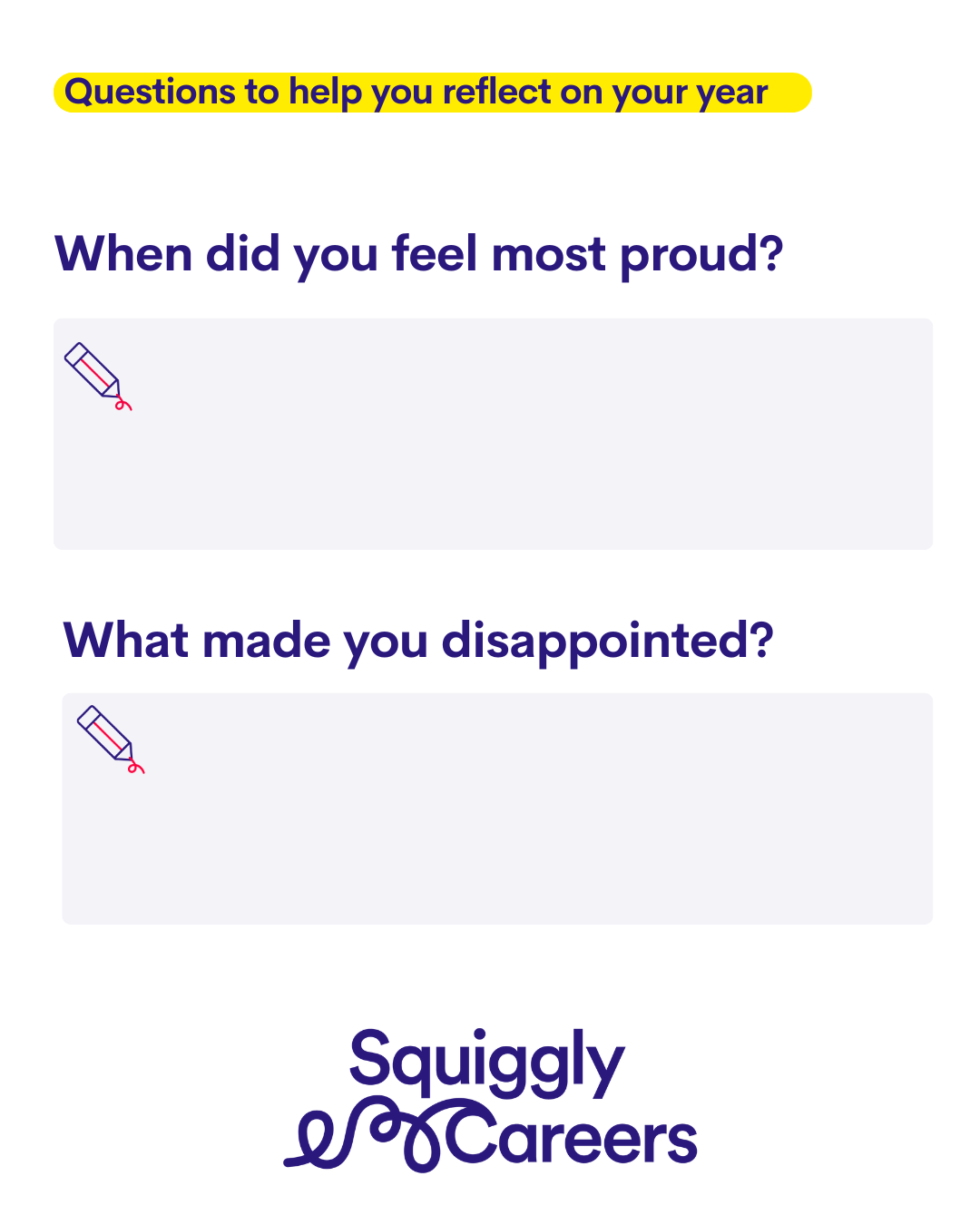
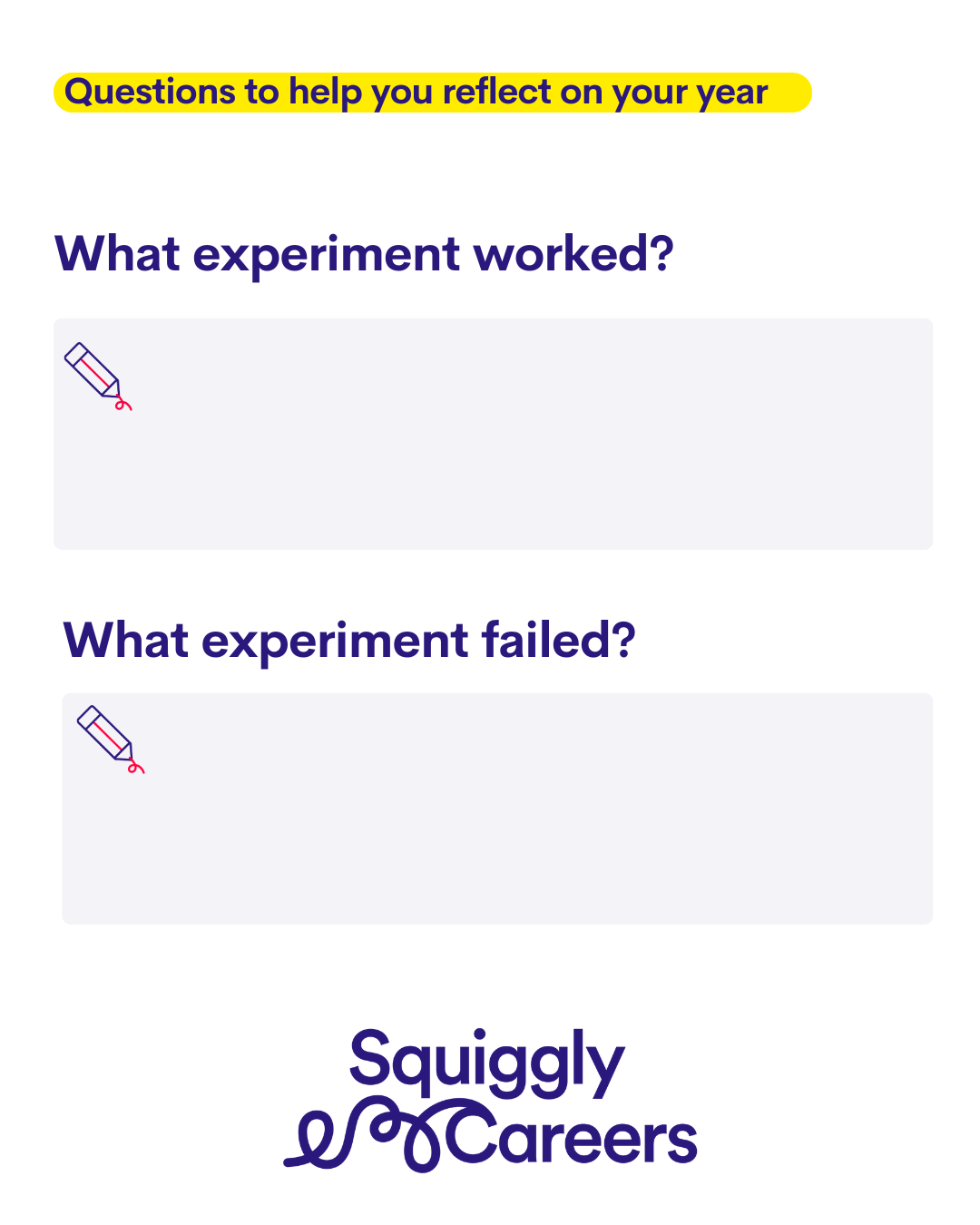
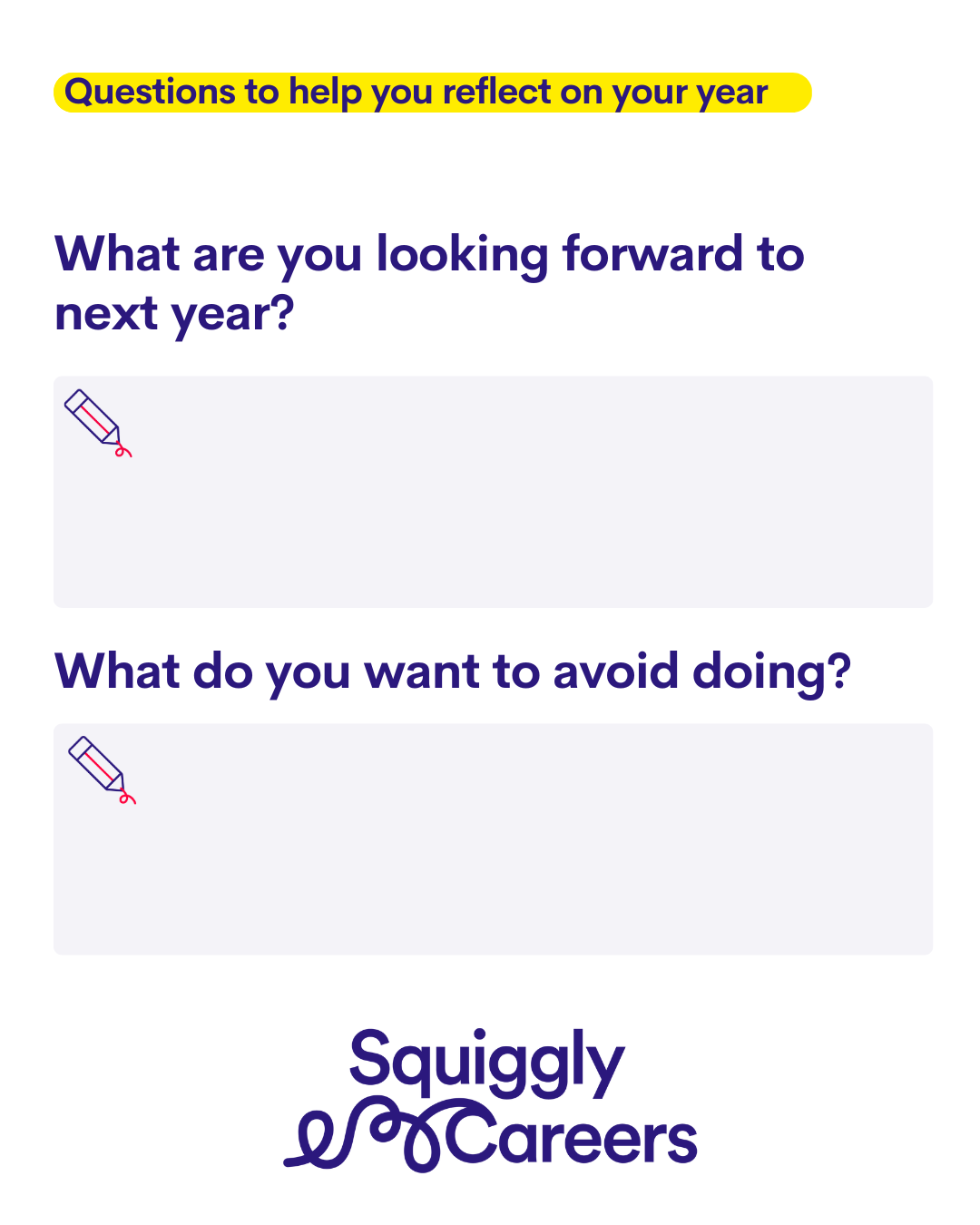
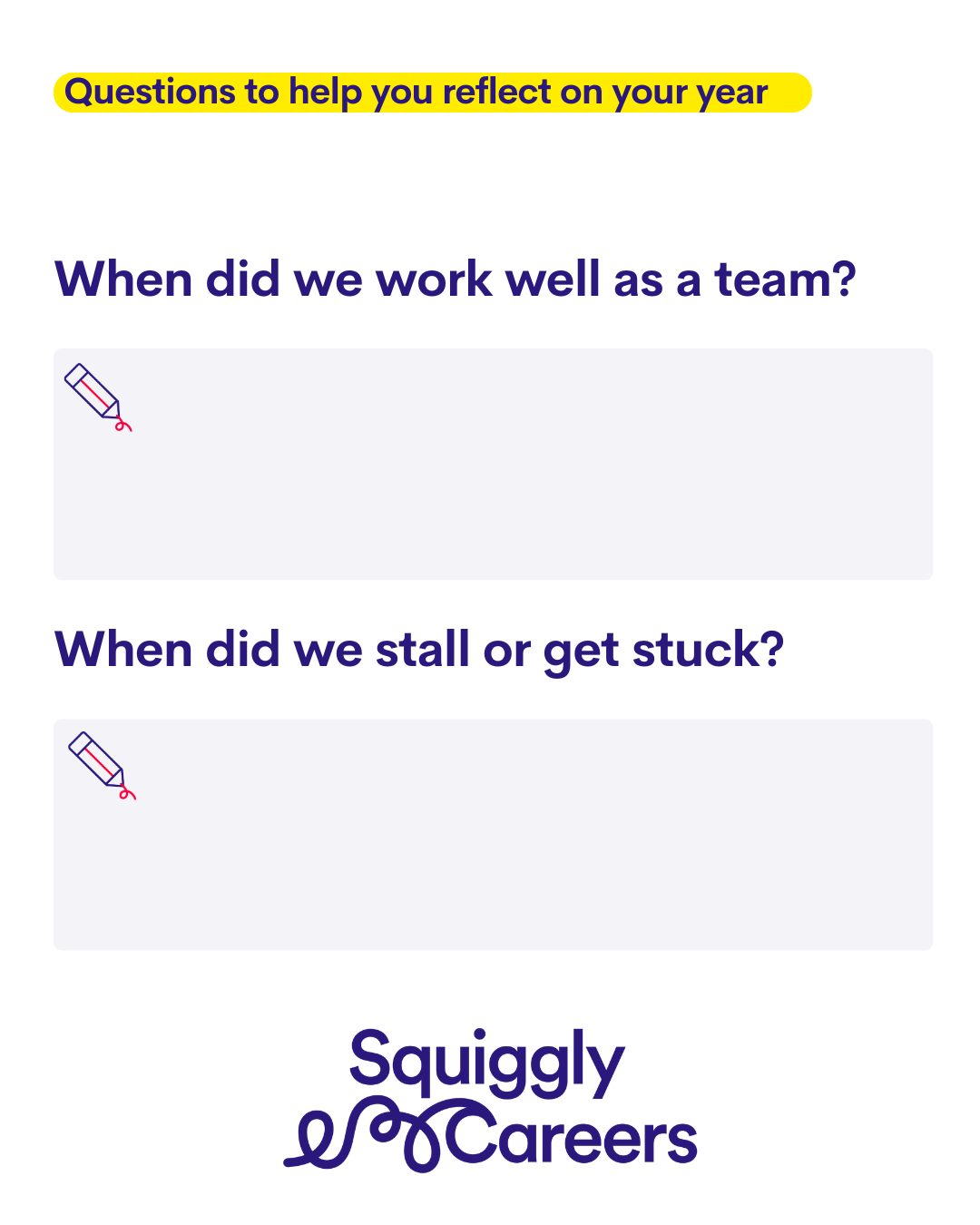
46:20 Reflection questions you can use too
Helen Tupper: Hi, I'm Helen.
Sarah Ellis: And I'm Sarah.
Helen Tupper: And this is the Squiggly Careers podcast, where every week we borrow some brilliance and relate it to you in your role and in your career, to give you some ideas, some insights, some things that you can take action with, to invest in your development. And today is a bit of a special episode. I think. This is one that we've done for the past few years. It's where Sarah and I do a bit of a year in review and we use some questions to support our reflections, questions that we think are useful for everybody. But to bring those questions to life, we will, we will talk them through. We will do our year in review with you. And our focus for this year review is going to be on high, low learning. So we've got several different questions. We're going to share our answers. So I think if you are a fan and a follower of Squiggly Careers, you're probably going to get to hear some of the stuff behind the scenes.
Sarah Ellis: Behind the scenes, Squiggly behind the scenes. For better, for worse.
Helen Tupper: Yeah, you're going to get the real thing. But I think if you're not a fan, don't worry. There are several questions here that we would suggest that you either reflect or for yourself on your year or ideally, you do this with someone else, you do it in a team, you do it with a bit of a learning buddy. I think it kind of just creates a nicer learning environment if you can use these questions with other people. But it's going to be chatty, bit informal. Sarah and I have not shared our answers with each other. I've got a cup of tea. Sarah's in a room where there's a really loud guy talking outside. So, you know, it's.
Sarah Ellis: And she's too scared to go and say, can you please talk quieter?
Helen Tupper: I mean, you can't. Really rude.
Sarah Ellis: You can't. You can't be like, I'm recording a podcast.
Helen Tupper: I feel like you can't. We just.
Sarah Ellis: I know such. Also that makes you sound like sir. A deep.
Helen Tupper: It doesn't it?
Sarah Ellis: You know, just like you do. You do realise I have a podcast.
Helen Tupper: I'm recording a podcast. So it's going to be informal, everybody. And we will put these questions in the pod sheet, which you can get from our website, amazingif.com Afterwards, if you want to use them to reflect yourself, use them with a team. But yeah, I think this is. Grab a cup of tea, sit and listen with us and hear some behind the scenes stuff from the World of squiggly careers.
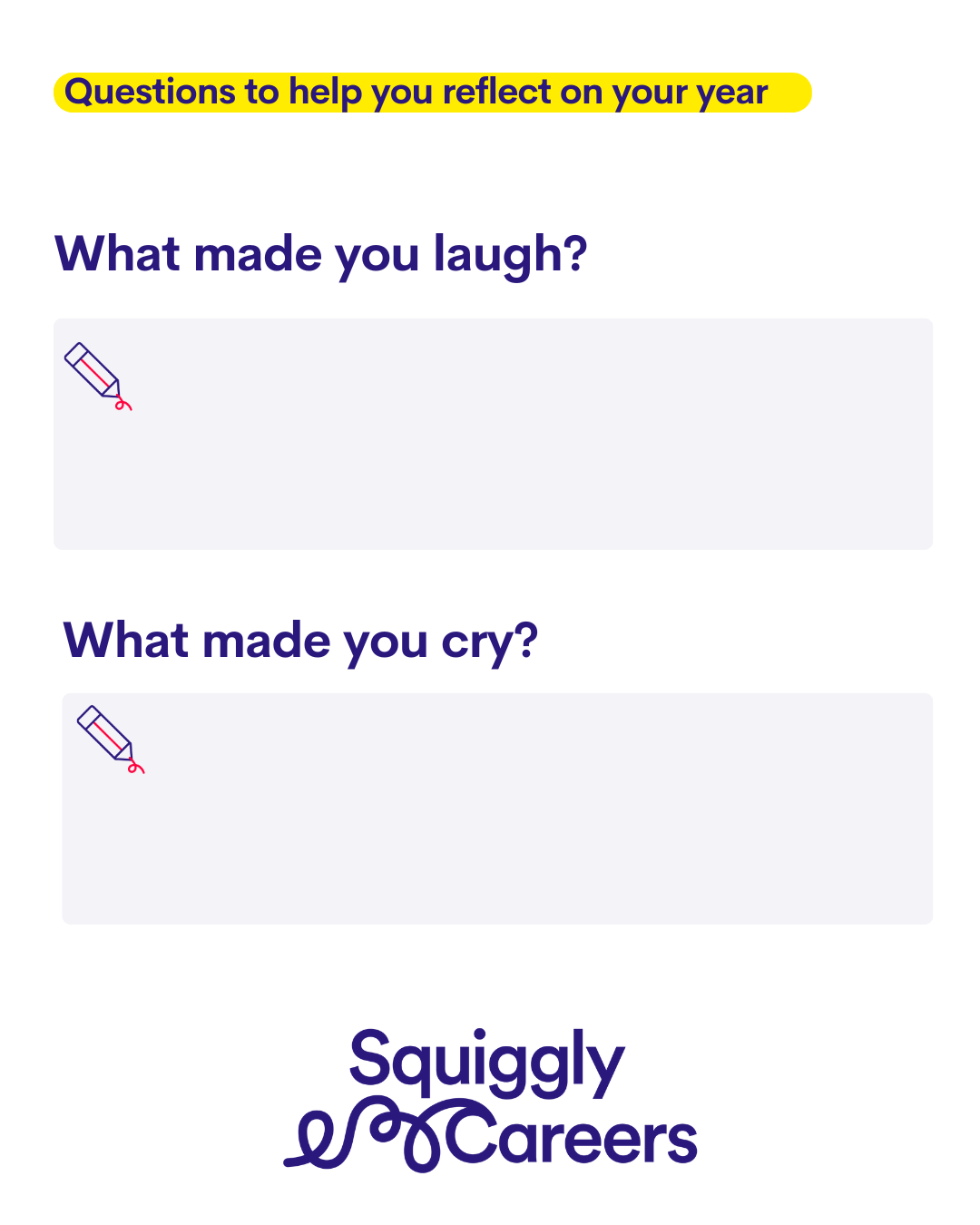
Sarah Ellis: And so the way that we frame today is high, low learning. So for every question that we've come up with, we're kind of going to contrast something that's gone well that we might want to do again or kind of do more of because we don't want to forget those. It is important to think about, like, what, what's been the good stuff and then also a low because I think they are funnier. When I was writing mine down, actually, I was like laughing to myself, I.
Helen Tupper: Can'T wait to hear them.
Sarah Ellis: But I also think you learn as much from your lows as you do from your highs. I was reflecting. I don't think it means the lows go away because I think you just get new lows. But I. It has made me think a bit about actions and like what you might do differently. Given those are your lows. Like, what do they have in common? What's helped you through those lows? I think that's probably the kind of theme that came up for me was like when I looked at all my lows, I was like, there are a few common actions that really helped me through those hard moments. And I think being aware of those can just help you when you, when you have those low moments. So should I ask the first question? Helen, are you ready?
Helen Tupper: Yes, I'm ready. Ready.
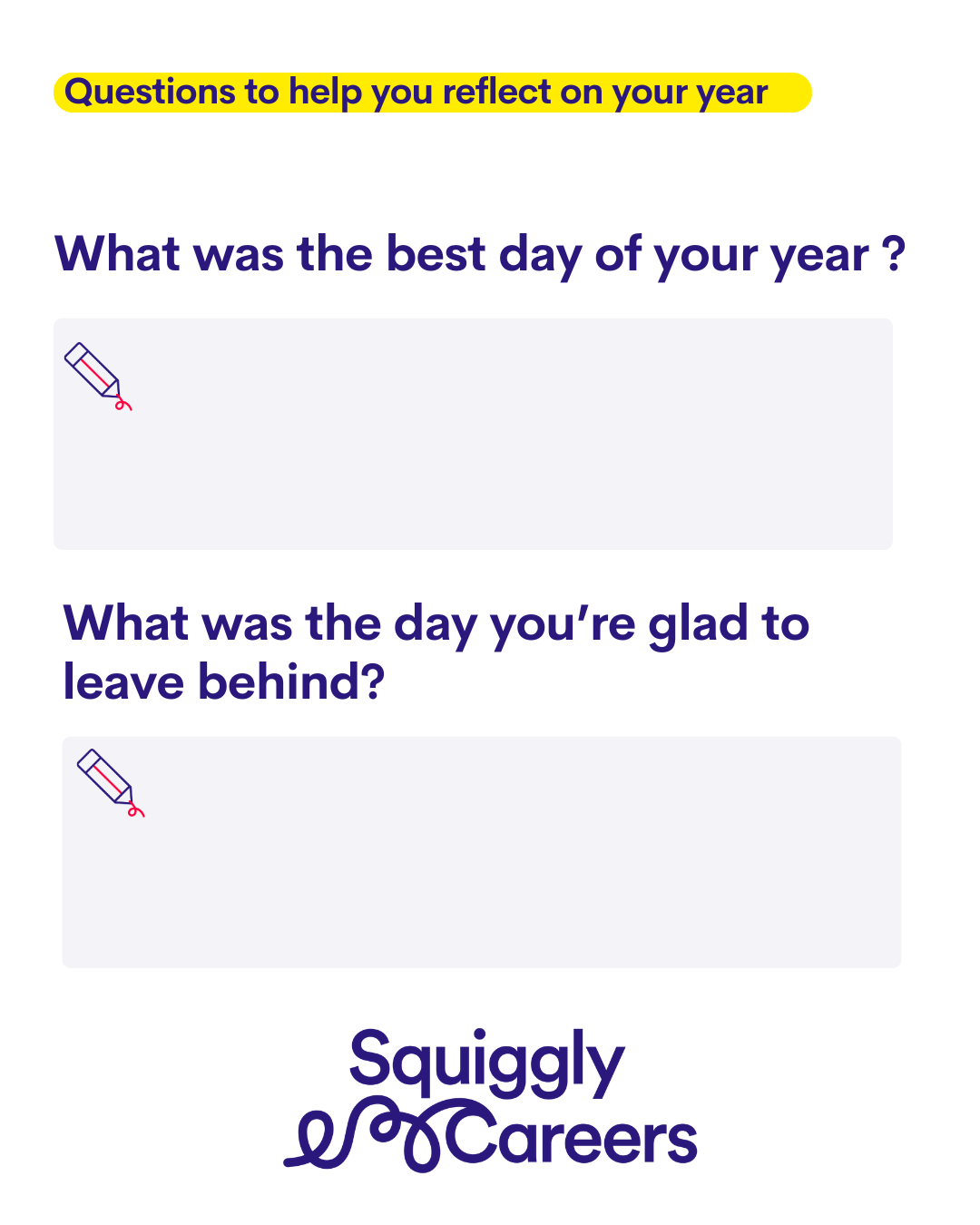
Sarah Ellis: Okay. So first. Hi. Le learning. So, hi. What was your best day of the year? Low. What was a day that you were really happy to leave behind?
Helen Tupper: Okay, my. I can't wait to hear yours. I'm excited. So my best day of the year was you and me together in Dorset. Is it the same as you?
Sarah Ellis: In a village hall? In a village hall, yes. Say what? Oh, we are as one. Which actually is quite rare.
Helen Tupper: We should probably explain that to everybody. So we tend to take a couple of days out in like the middle of the year for whatever big project we're working on, which at the moment and for a lot of this year has been our new book, Learn like a Lobster. And we go somewhere different to our everyday because it just helps us with our thinking. So we're in Dorset and we couldn't find a meeting room because there aren't that many co working spaces on.
Sarah Ellis: On the coast of Dorset in the uk.
Helen Tupper: So Sarah had a bit of a brainwave which was to look at village halls. And there was an amazing village hall in Sudland, I think this huge space. And we took over. I mean it cost like, did it cost us like £30 or something?
Sarah Ellis: I would say top tip. AI found that space for me. So I did use. I was like, oh, I'm just going to use Claude, obviously my favourite AI for people who've long gone listeners, me and Claude, my new best friend. I could. At what point could Claude replace Helen? I could just conversation with Claude. But Claude found that village hall and it was like, what about using this village hall? It cost like £25. And I was like, sure, why not? And it was just. I mean, it was a, like massive space, wasn't it? It was just the two of us.
Helen Tupper: With these yellow posts and there was.
Sarah Ellis: So much more space.
Helen Tupper: It was brilliant.
Sarah Ellis: It was brilliant. I think it was also just exactly what we needed. Like we could move around, it got lots of natural light, we could take breaks really easily. And I think the reason I picked it, as well as my high, was not just the day, but I think we made a real commitment to make sure that that day mattered beyond the day. So we're often quite good when we're together. What we are less good at is kind of what comes next. And I think that is our best ever. We followed up on those actions, we have made those ideas that we came up with on that day happen. So the reason I actually chose it as the high was as much as I enjoyed that day and I did, that's like, I just. If I could do that more often, I definitely would. I then found my notes the other week when I was like clearing some stuff out from that village hall day and I was like, oh, we've done that. And we did that action and we made that happen and that worked and that didn't.
Helen Tupper: But.
Sarah Ellis: But those ideas mattered. They've like made a difference. So I think that was why it was my high. It was kind of what came next.
Helen Tupper: I think mine both because it was enjoyable, but also I think that is you and me at our best. So Sarah will stand up. It's like really weird. We just have this way of doing it. Sarah will stand up with, post it. And the minute we have an idea, Sarah will kind of put it down on paper and put it on a wall. And it's really good because it's sort of low commitment, low perfection. And Sarah's very, very quick at generating the idea, putting it up. So you very, very quickly get this ability to see lots of ideas in one place. And then I am quite good. I will literally sit in a chair and I am very good at then, like, looking at all the ideas and kind of like making sense of them. I'm like, hang on a minute. That one over there is probably better with, there's something that happens in my brain, but it can't happen unless I have a volume of stuff that I see. And so this, I don't know, there's just this fit between yours and my brains in that moment that works really well. And I always. And we don't do it that often just because of the, you know, the way that we run our business and the demands on our time. But I just love it when it happens because that's where the good stuff, that is where the best stuff comes in our business.
Sarah Ellis: And obviously, you know, my partner because we, you and I have worked together for a long time and known each other for a long time and I've been with my partner for a long time. And wasn't this the one time ever that he sent you a WhatsApp message?
Helen Tupper: Yeah, he did, yeah. Tom doesn't message me very often. I don't think he messages you that often. He sent me a message and something along the lines of, I think you might have broken Sarah because there was just this picture of like post it notes and teacups and things like all over your house that I think you've been so immersed in your thinking for this day that your actual home life had taken a bit of a hit.
Sarah Ellis: I think it was our bedroom, so our bedroom was covered with. So I prepare for those days in a very different way to Helen. Like, if I don't have the time and space to reflect by myself first, I sort of can't do what we need to do when we're together. And I actually don't need Helen to do that. And she doesn't need to do that. She can just sort of turn up and be in the moment. But I really think things through and I like to connect dots in my own brain first. But the problem was that was in where we sleep and our whole wall and all of our mirrors were all covered in these massive yellow post it. I didn't know. But yeah, he just sent a message to you being like. I think he said something like, it's either the work of a genius or a psychopath. So I was like. At that point, he was like, I've lost her, I've lost her. What about a low? A low that you would like to leave behind?
Helen Tupper: I was thinking I went through my phone to sort of trigger me for the year, you know, to avoid like the whole recency bias thing. And then I remembered, I was like, oh, that was a bad. So I went on a work trip to Lisbon. Well, it was, it was with the ey winning women. Do you remember? And I got a bug. And it was on my first day. It was like a three day work trip and I got a bug. And, you know, we don't need to go into that, do we? But I. I could not leave my room for 24 hours and I'm not really very. I'm not ill very often and I don't like.
Sarah Ellis: So sorry for you.
Helen Tupper: And I'd gone that way for that. You know, that's an annual event of three days for those women. It's such a brilliant event. I basically just stayed in my room in a really nice. I also really remember the dress because I'm always really conscious, like, I want to look nice at those events. And I'd got this really nice dress and I just lay in my bed for like 24 hours because I couldn't even get. I couldn't even get my nice dress off. Yeah, it was not a nice moment. Yeah, it was pretty bleak. What about yours?
Sarah Ellis: Mine was. Do you remember Windy wi Fi time?
Helen Tupper: Windy wi fi.
Sarah Ellis: So when it got. Yeah, so when there was. There were storms and it was really windy and that wind basically broke my Internet. Do you not remember? Because you helped me get a hotel.
Helen Tupper: How did you remember? Oh, yeah, didn't I discover a hotel near you? You were like, oh, I didn't realise that hotel was there. Yeah.
Sarah Ellis: So I think it was just, you know, it was really stressful because you didn't know it was coming. And our work really relies on, like everybody having the Internet. But I think when we're doing workshops for big groups, they're big moments that matter. People have put a lot of effort into them. If your Internet breaks, it's a pretty big deal. And I just think the amount of adapting I then had to do in like 24 hours from. I ended up in one co working space quite near, quite near where I live, but not that near where. I don't think this guy, I don't think he'd welcomed anyone to this office space in a long time. And also everyone there was male.
Helen Tupper: And then they were just like, oh.
Sarah Ellis: And I felt like they were just looking at me through this, like, glass door being like, who is this? She's interesting. And he knocked on the door in the middle of a session that I was delivering for Lego to ask me if I wanted a digestive biscuit.
Helen Tupper: That is very sweet. I mean, it's quite frustrating when you're trying to deliver a Workshop. But it's very.
Sarah Ellis: It's a very.
Helen Tupper: It was.
Sarah Ellis: And he was like, can I make you a cup of tea? And I was like, I'm literally delivering a workshop for hundreds of people. Please don't talk to me. And, you know, you just like, it's just. And he was. He was. He was so nice and so intrigued by me. So I did that for one of the windy wi fi days. And then that night I was really panicking and I was like, right, what can I do? And then, yeah, you and I were re. I think you found a hotel. You were like, this hotel looks like it's quite near you. And then you booked it. And then I turned up and you told them. So what we'd done was you'd booked a hotel room for me. I then turned up the next day and they were like, oh, no, we've given it away. And I was like, but we put a note to say we're not going to be here until the next day. And I just stood my ground. I was like, you have to find me a meeting room then. And they were just sort of looking at me like, oh, but we've cancelled it now. I was like, yep, I get that. But you must have somewhere that I can work.
Helen Tupper: I will sit in your office.
Sarah Ellis: Well, yeah, I mean, I would have totally sat in their office if they'd have given me that. If they would have been like, do you want to just come here? I'd be like, yeah, that's fine. But I was just. I think in our work, generally, there are sometimes those things, like technology or travel. I've had some travel things this week where you just go, they will happen. You can't stop them happening. And, you know, I said to you about, like, what do you learn from your lows? I think it is just sharing fast that you've. You've got a barrier or a roadblock so that people can help you. Because sometimes what you need is just like, oh, that sounds like a nightmare. You just need that from people. But also sometimes you just, like, people have fast fixes that maybe you've not thought of. You know, oh, what about this? Or have you thought about this? And you're like, right, okay, yeah, you actually just need lots of ideas and then you can just explore them quickly and see what's most helpful. So I think just not keeping it to yourself. I think previously my personality is actually the more stressed and worried I am, the less likely I am to share something. I sort of get a bit like, in my shell, but I have. I've almost taught myself now. I just never do that now. As soon as something feels hard, I'm just like, right, basically, who can I tell? And then I'm like, I never. You never quite know, like, whether they'll be able to help you or not, but sometimes I think just sharing it with someone.
Helen Tupper: So it's.
Sarah Ellis: It's sort of a, you know, like a problem shared, it's a problem halved. That has helped me in more than one situation this year beyond Windy Wi Fi. But, yeah, I didn't enjoy Windy Wi Fi Day. Yes. Should we do the next one?
Helen Tupper: Yeah. Where are we going?
Sarah Ellis: Let's do experiments next. So a high. An experiment that has worked well for you or for us, I guess, and an experiment that has failed. So kind of a low, which we should say. Obviously, the only experiments that fail are ones where you fail to learn. So actually there's no low here because you're experimenting. But I do think it is really helpful to reflect on things you have tried out this year, what you have learned, because the experiments that have gone well, you obviously want to do more of that. You kind of want to keep that momentum going and if it's failed, that's kind of fine. But what you don't want to do is like, lose. Lose the learning from that. I wonder if we've got the same one here.
Helen Tupper: No, we're going to be ready if.
Sarah Ellis: All of our different ones.
Helen Tupper: Definitely, Deb. Different. So my experiment that worked were my.
Sarah Ellis: Like, meetups, I don't know what else.
Helen Tupper: To call them, but the squiggly connections and conversations meetups. So I did one in Edinburgh, I did one in New York, and I was there for work reasons in both of those places. And I thought, you know, whilst I'm here, I'm gonna look who I know, like in these areas. And I just use LinkedIn. I literally went, because I couldn't think, who do I know in Edinburgh? Who do I know in New York? So I just went on LinkedIn and I looked at who I was connected to. So, like on LinkedIn you can do first, second and third, like degree connections or something. So I was like, who am I actually connected to? So first person connections, whatever that actually means on LinkedIn. And then you can search by city. So I did first Edinburgh, first New York. And then I literally went through all those people and was like, hi. I just messaged them. I was like, hi, I'm in. Blah, blah, blah on this date.
Sarah Ellis: Yeah, you're so good at doing that.
Helen Tupper: And in Edinburgh. I took slightly different approach. In Edinburgh I did lots of coffees and they were amazing. Really, really, really useful. And in New York I did some coffees and then I also. It was very daunting. I was like, experimented with like a proper meetup. I was like, I'm gonna.
Sarah Ellis: I know, you just did like an event. I was like, where are you? You were like, I don't know. Really some part of New York.
Helen Tupper: I was like, I don't, I also don't really know New York. So I was like, I don't know if this is a good place or a bad place, but just got a rooftop, got a couple of bottles of wine and some non alcoholic drinks for other people. And yeah, the bottles weren't just for me, I should say that made it.
Sarah Ellis: Sound like I got a couple, I got a couple of bottles of wine just to increase the confidence and feel good.
Helen Tupper: Everybody obviously. And yeah, then I invited these people and it was so, it was so good and it felt it was an experiment because I didn't know if people were gonna wanna come and I didn't know if they were gonna turn up. And I could have just been sat on a rooftop on my own. And I was a bit nervous. I mean I got there before it opened because I was like, I need to be the first one here.
Sarah Ellis: I remember you sending me like WhatsApp messages.
Helen Tupper: So embarrassed.
Sarah Ellis: And I was like, I really hope people turn up.
Helen Tupper: So embarrassed. But it did work and it was wonderful. And I have actually. One of the people that I met there is actually gonna be on our podcast in February. So you know how those things can lead to things. I guess is my brave things can lead to things. So that was my experiment. That was a high. What about yours?
Sarah Ellis: No, you do your low. Because my high and my low are connected. So it'll make more sense to do them together.
Helen Tupper: I'm so intrigued. My low. You'll laugh at this. You'll be like, I'm glad that failed. I know you will. Was posting every day on LinkedIn. So I went on a. I would.
Sarah Ellis: Never be glad that you said, are you sure? What does that say about me?
Helen Tupper: I think it's a good thing.
Sarah Ellis: Of course it means I don't have to like defriend you on LinkedIn. So that's quite easy.
Helen Tupper: That's true. But it's an interesting experience. So I went on a course which was all about kind of building your LinkedIn profile. And I already have. You know, LinkedIn's already quite an active.
Sarah Ellis: Very good LinkedIn profile.
Helen Tupper: Yeah, I'm already quite active on there. But I do see it as a really good way that we can find new people with squiggly careers. So I want to. I want to invest in. It's a really good way for us to grow. And I was on this course and there was lots of advice and I followed it. And this one of the things, and there was many bits of advice, but one of the things was posting every day. And to be honest, force. There were some benefits of it. So for like, forcing yourself to post every day means you have to be quite intentional about what you're sharing. So it probably made me a bit like when I used to do career tips every day on Instagram, it made me kind of go, oh, what is new?
Sarah Ellis: What is a bit of a forcing function.
Helen Tupper: It was a real forcing function for my curiosity and my creativity, actually. Like, how do I turn that thing I've read into something that's useful for somebody?
Sarah Ellis: I mean, some of the things you managed to come up with during that time, I was like, how has she created content one pages?
Helen Tupper: And I was just so much stuff. And actually some of my most shared stuff came from that time. So I think, okay, not everything fails. No, not every. In fact, on paper, it probably worked as an approach that. For lots of reasons, but I think it failed because I didn't stick to it. And I think what I have learned is that I. Sometimes I think you just got to do stuff that's right for you. Because I could have really beat myself up about that, you know, I didn't. I was meant to post every day. That was what I committed to and blah, blah, blah, blah. And I just didn't. And I kind of have gone back to what I was doing before, to be honest, with maybe a bit more insight into things. But I think it's okay sometimes to try something, you know, you might look at someone's advice or look at what someone's doing and go, well, I've tried it, but that's not for me.
Sarah Ellis: So.
Helen Tupper: And not to feel the pressure of having to show up in a way that other people are or do something because everyone's saying, well, that's the new. That's the new cool thing to do. We should all be doing it. I mean, fair enough, give it a go. But if it doesn't work for you, then let it go at the same time. So it was, you know, it was a failure. But I think I also kind of took a bit of, maybe a bit of confidence from, you know, the Running your own race thing sort of reaffirm that for me.
Sarah Ellis: Yes. And also, you know, there's sometimes a difference between what might be right for an algorithm versus what might be right for you. And I'm like, do you really want to live your life based on algorithms?
Helen Tupper: Because?
Sarah Ellis: Because I don't. You know, and you're just like. And I understand that people having that awareness, they might be like, well, I need to build my profile on LinkedIn to help my business. But if I think about all the people I follow on LinkedIn who I really like, like you, I think they know the principles and they're kind of smart about how they do it, but they are also thoughtful and intentional. You know, if you think about someone like Joe, Joe Glover, I always really like his LinkedIn posts, but I don't feel like I see one every day. I feel like he just does them. I feel like he's actually a very different sort of person to you. I think he's much more introverted than you would be, but he's like you. Like, he always posts in a way that feels like useful but still personal.
Helen Tupper: Sophie Devonshirt as well. Shout out to Sophie. He's a CEO of the Marketing Society. I think she always posts. Yeah, she posts in a very thoughtful way.
Sarah Ellis: I like Sophie's posts and very consistent.
Helen Tupper: Because she's all about kind of curiosity and connection. So there's like that consistency. Yeah, yeah. I think that's probably a good insight as well. Like with particularly those things, find the people who you admire, but again, you don't have to copy them. But it is interesting to kind of think, well, what is it that I like about what they do?
Sarah Ellis: Go on then.
Helen Tupper: I'm picking up the cup of tea. I want to hear these connectors.
Sarah Ellis: Yeah. I don't know how much you're gonna. I don't know how much you're gonna like.
Helen Tupper: No, you will.
Sarah Ellis: You will like this. I'm ready. So my sort of experiments that have worked and failed, which are definitely not just mine, they're definitely ours, are actually all about the podcast. So I feel like we got to a point with the podcast where we felt really stuck and experiment really helped us to re energise, get some momentum, get started, you know, not overthink. I think we were. We'd got some questions that we were struggling to answer and we were definitely going around in circles with the podcast. I think I was annoying both of us for then different reasons. You get definitely like a. Well, just turn up and do it, Sarah. Like Stop asking questions, turn up, record the podcast, walk away. I get to. Well, I'm just going to stop it then, because if that's our attitude, that's it. So I think, you know, the, like, parent child thing, I think we both go in quite different directions there. And actually it doesn't. Obviously it doesn't serve either of us. And also it means that you just don't enjoy it. Like, we've always enjoyed the podcast. I think Squiggly Careers came from you and I connecting to talk about careers in a way that was useful for us and we hoped was useful for other people. And I think that's like, that is us at our best. And so I think when we sort of stopped worrying about answers and started just going, okay, so what could we experiment with? How about this as a format? Or what might this look like? And let's just find out. Don't put too much pressure on ourselves, you know, remove the whole pressure to be perfect. And I remember saying to you, what about just doing Borrowed brilliance every week? That might just be a different way to do things? And you were like, yeah, okay, I can see how that would work. Tested it really quickly with a couple of people, like, that day, and then we've just done it. And I think in terms of, like, people listening might be, like, doesn't feel that different.
Helen Tupper: Yeah, yeah.
Sarah Ellis: But I think it's felt. And I would get that. I'm like, yeah. So every week you're just talking about something about careers and you're trying to make it useful. But I think it has felt different for me. Like you said, it has ignited curiosity. It's given a different kind of way into conversations about careers. I hate the idea of being repetitive or doing things that we've done before because I feel like that's not useful. So I'm always kind of naturally very critical of that. And with Borrowed Brilliance, I'm like, oh, it feels new. It feels new again. It feels interesting. So that has been. It's almost where, like, experimenting, just the act of experimenting has really helped. Like, I'm so convinced that experimenting just helps you move forward with so much more pace and you make more progress. And then really quickly, you can see, like, data. Does it work? Does it not? And some of the data for us on that experiment was, how much are we enjoying it?
Helen Tupper: Yeah.
Sarah Ellis: And I've just enjoyed it so much more. I think we've been doing it maybe for, like, three months now.
Helen Tupper: Yeah.
Sarah Ellis: And, you know, like, the conversations have felt different.
Helen Tupper: I think. I. Yeah. I mean, I could have continued how we were, but I think not with you, the way that you felt about it. So I think for me, I was like, I have to find a way for Sarah to re engage and want to do this because I think we were. We were in danger of like, stopping the podcast, which I didn't want to do because I love doing it and I think lots of people listen to it. So I think we just needed to find a way that your brain found it. Fun's not the right word, but your, Your. Your brain was engaged in it again. And I feel like we've kind of cracked that. And now I like it more because now we get to talk about random things like marshmallows and breathing chairs. So I'm like. So I'm kind of engaged because I love the randomness of it. And I think for you, it just feels more creative and relevant and interesting to do rather than just kind of like, how do you run a one to one? Which just felt like we were. Which I'm not.
Sarah Ellis: Oh, we've done that.
Helen Tupper: We've done it.
Sarah Ellis: Do a good one to one, but we've done that. So that's been a brilliant experiment. I think the thing we've also been experimenting with then, like, how to record and, you know, we now do it so that people can watch it as well as listen, which is fine. Like, I'm fine that people watch it. I've got past the point of getting worried about that. But certainly the logistics of our podcast, everything we have experimented with, I would say this year, like, hasn't. Hasn't really worked and it's felt frustrating for us. It's definitely felt frustrating for our team. It's definitely not fun. It would be, I think, top of quite a few people's list of like, this creates problems and issues and we just haven't quite sorted out. It's almost like the behind the scenes of how you make the podcast happen. So when we have the conversations now, like, great. But all of the other things that often people won't see that goes into making the podcast end up sometimes feeling really hard. Like, the schedule doesn't feel very flexible. It doesn't feel like it reflects how we both work. If we don't do one because something happens, like we're doing work with a partner all of a sudden or one of us is ill, it creates a whole cascade of challenges. We missed one the other week for some reason. Oh, I messed something up and you're like. The amount of challenges that create. It was like one Hour of something going wrong that created, like, an incredible amount of work. And, like, you know, just like so many issues, so many problems for something where you were like. And I'm like. I look at that and think, oh, I'm almost like, when you talk about, like, disappointed, I'm always like, disappointed in myself, in us. I give myself a really hard time for that. And so that's one where I think you've got to accept sometimes that experiments just aren't working. And what I would have liked to have done sooner when I've thought about this is I don't think we've called it fast enough. So actually, I think because almost the conversations are working better, I think we have lived in the messiness of the logistics and those kind of things, like not working, making our lives way harder rather than easier. And we've just kept living with it, you know, because sometimes it is easier to live with it than it is to call it out. And actually, I think that's one of the things that I want to get better at next year is the fast flags, where things are feeling hard or where I'm getting a niggle that I'm like, this doesn't feel like it's working now. I think it's then absolutely okay for then someone to challenge you back on it and say, we've not given it long enough and that's fine, you know, like, you can't go too soon. But I feel like sometimes, because you and I have so many different things that we do, having the capacity to call it or to do the fast flag is actually sometimes quite hard. And actually, as a team, I wouldn't say saying the hard thing is like a natural skill that we have as a team either. So often saying the hard thing does rely on us saying the hard thing, because our team are supportive and they just want to help things and they just want to make things happen. And they're often quite like, in the moment, how do we make the podcast happen for next week? That's kind of the starting point. And so I think I want to do some new experiments with the kind of. With that. And we've already started thinking about what that might look like, which none of our listeners will particularly care about, because they'll be like, well, just give me the podcast every week.
Helen Tupper: It's a big difference, but it makes a lot of difference how people feel.
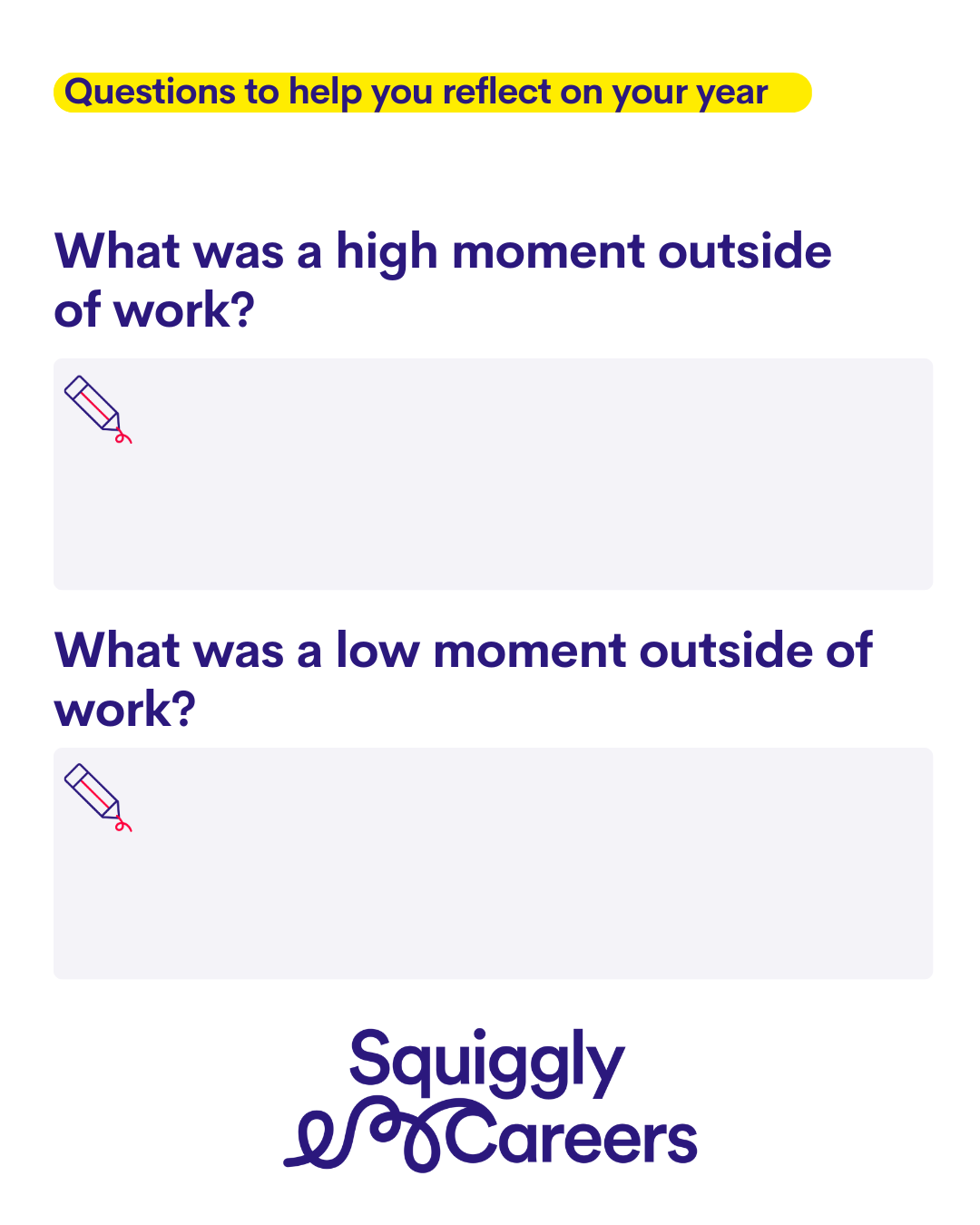
Sarah Ellis: It makes a difference to us. Yeah, yeah, yeah. So they were my 2 now. I thought it was helpful to have a high and low from outside of work. I Will admit that I wrote this question. I know. And my sort of guilty admission here is that I wrote these questions for Helen and I to talk about, sent them to Helen and then about three days later added one where I said oh, probably we should reflect that we have a life outside of work. Because I hadn't asked a single question that was about life outside of work. So a. Hi Helen. That was nothing to do with amazing if and maybe a low as well. More about kind of life outside work.
Helen Tupper: The reality cheque. So my high outside of work has been renovation based. So this has been a year of. I mean an awful lot of mess where I live but have done quite a lot of work at my house in the garden and also in my office. It looks beautiful in my office now, which is not kind of fully finished. But these are spaces that for me they're just like, honestly like really important to my mental health. I know that sounds weird but like we spend a lot of time in our office because Sarah and I deliver workshops all to all hours of the day, lots of companies. I'm, you know, like many of us, I'm. I'm in an office quite a lot and so my space here feels really important and so I feel like I've made this nice. I'm really excited to be in here. And then also I live in the countryside and I find it very. I found it just a very grounding place so I can be busy, busy, busy. And you know, Sarah will often say I'm an extrovert and I am but then I have this sort of this extreme moments of introversion. So I'm like, I'm like 90 extrovert and then 10 extreme introvert. When I just want to be in like in the country, in the garden doing like very. I don't want to be with other people, I just want to be with my family. And I find it really, really grounding. And so investing in those areas of my life this year means that I'm ending the year. I just feel really happy, honestly. I look outside, I sit my office and I'm like happy, really happy. Oh, hello.
Sarah Ellis: As well.
Helen Tupper: There's always good reality cheque. Milo is actually quite a. It's a. This is probably a bit recency bias one but I generally don't reflect for a long time on Lowe's. But my, my nanny who again regular listeners will know that I talk about my nanny all the time and the new book, my dedication in the book is to nanny. She can't be with me this year for Christmas because she's 96 and she just, you know, she just can't be with me. And it is the first 96. She's 96. She just can't be with me this year. I will still go and see her. I'm gonna see her twice over Christmas. I'm very, very close to her, but it's the first time in a long time that she won't be spending Christmas with me and that. And it just feels. It just feels a little bit hard. So it's a bit. It's a little bit sad, but it is the reality of life and she is the most amazing woman and I still get to see her. So it's not sad, it's just, you know, it's just. It's just life. It's just life. Go on, what are yours?
Sarah Ellis: My high was a trip to Iceland. So me and Tom, my partner, and our little boy Max, we went to Iceland in July. And it was just like the perfect mix of different things to do. So we went to Reykjavik. I saw whales. I love animals generally, but we went out onto the water and there was quite a lot of whales. When you're like a wonderful sea one and then you see quite a few and you see different types of whales. And that was just, I don't know, it was like magical. It was just so exciting. And I really like Reykjavik as well. Our Airbnb was around the corner from a really cool coffee shop. So I felt at home very quickly, other than it is just so expensive. I mean, London is expensive, but then I do feel like Iceland just take it to a whole other level. And so we'd spent some time in Reykjavik, but then we also travelled around and we did all sorts of like, just really like fun things. Like we walked behind like a massive waterfall, we went to like an ice cave and we went into a lava tunnel. Anyway, it was all very naturey, quite outdoor, outdoorsy, but also it was fun for everyone. And my partner always says you should aim for a holiday where it's like an eight or nine out of ten for everyone. But that is quite a hard ask, I think, when you've got an eight year old and then you know us. And that holiday was much more similar to probably the holidays that we did pre having kids. So it's helpful that our little boy's a little bit older now. But we also managed to mix it up by going like zip lining, which is actually very, very fun. And a little mini bungee jump, which actually was a lot less fun. I actually found that really sc. Like, I'll be fine. Like, I like all those kind of things. But the bungee jump, there is like a moment of weightlessness that I did not enjoy. I was like, oh, I'm gonna die.
Helen Tupper: When you question, you're like, why am I, why am I doing this?
Sarah Ellis: My life choices in that moment. So, yeah, that was just. Oh, it felt so different to things that we've done over the past eight years. And when I say different, like in the main, better. So that was, that was super cool. The low was interesting. I didn't have like a specific day or a specific week where I was like, oh, that was a low. I think my reflection is that because our work is so full on, the thing that I still sometimes struggle to manage is just the, you know, being present in evenings and kind of weekends and sort of switching off, like the work brain. And I think because we also both do work at home, it's funny, like, we're out and about a lot, but then we're also like you say also at home a lot working just that, you know, like, put your phone down, close your laptop, actually talk properly to people and, and not then just kind of go back to working. I don't feel like this year I've probably got my boundaries quite right. And he. And actually my 8 year old called me on it the other day because he sees, when he talks about like Google, he says what, he says like, can you research something for me, mum? And I was on my phone the other day and he was talking to me and he was like, oh, what are you researching? And I was thinking, well, I'm not researching anything because he thinks I should be researching for him and I'm not. I was like doing a work email or something. And his face, he's just getting to the point where he's a bit older and a bit more aware and you can imagine what your role modelling will have a bit more of a ripple effect. And I'm not that good at putting my phone down and just kind of walking away or kind of stopping work and stuff. And so I think just one of the things when I think about next year is just to figure out what would be helpful for that. Because usually for me it's. I am a big fan of things like habit stacking. It's always really helped me, like since I've learned about that I've definitely got better at things because of habit stacking and it's stupid stuff. Like I found I've got where I put like my phone charger so I'm not always great at charging my phone. I'm sometimes a bit messy, one might say.
Helen Tupper: I don't think that people would know this about you, that you're like a bit, I don't know, scatty's not the right word, but you're like messy. But you lose stuff quite a lot.
Sarah Ellis: Yeah. I have bought a lot of pairs of headphones this year more than ever before. So some years I like lose my cards quite a lot, but I never lose them, I misplace them and I always find them again. I mean, I can see three pairs of headphones from talking to you. I've got some in and then some that I bought last week actually with you and then some that I think I bought a couple of weeks ago because I can't contemplate going on stuff. I feel like this is like a.
Helen Tupper: Little secret Sarah fact that people, they'll be like, Sarah's so like calm and collected and confident. I'm like, yeah, she is all of those things but she's also just really messy and she just forgets like stuff everywhere she leaves.
Sarah Ellis: And also the busier I am, the messier I get because I actually get very single minded. So even like today when recording the podcast, you were like, well, have you got headphones? And I was like, no, I've got headphones for my phone, but I haven't got headphones. And actually what. This is the genius of being messy. I then dug around in my bag just to see and I was like, oh, have actually got some. Who knows how long the charge will last? But actually it's lasted. So we're kind of all good. So id and I don't think that's good. I don't think that's good for me. Like generally a little bit of messiness is fine because that's just my actual personality, much to my partner's distress. But I think there is like, I can see a tipping point and actually I'm definitely in it right now. Like the pre Christmas messiness has reached new levels to the extent where my partner won't walk in a room that I work in and also have all my stuff in. He's like, he's like, oh, I couldn't. He actually said to me last night, oh, do you know where this is? Oh, but I couldn't. If it's in the study. I couldn't face walking in there. I couldn't face it. And I was.
Helen Tupper: Strong language that he used to.
Sarah Ellis: He used that language. I mean, it just makes me Laugh a bit. But again, that's not what I think he's looking for. So I do, I do think I sort of want to create a bit of a commitment to myself to just kind of be like, right, okay, how do I. Because work won't stop being busy. That's fine because I love it and I want, I want to be, I want to be doing all the things that we're doing. But you know, like, knowing it is okay to put your phone down for two hours, like, knowing it is okay to like leave your laptop behind and, and also just think about like, am I listening to my partner or my son when they talk to me? And I'm sure it's like, it's a constant calibration. Right, for everyone. But I don't, I don't always think I've got it right. This year I have done a lot of work though.
Helen Tupper: Well, that's a funny outcome of that. Well, when you've reflected on it, obviously, however I can help, let me know. I would say one, one thing, one thing is as you are reflecting on it, I think on that one, it's worth thinking about how much of the need to respond is real versus, like habitual. So as in actually if it's real, then we should put some rules in place that mean that certain messages don't come at certain times or we change people's expectations of responses. If it is habit, then that's something kind of for you to put those, you know, like, like, oh, I charge in a different place, all that kind of stuff. But I think, and actually I do.
Sarah Ellis: Think, I do think it's me. I actually don't think, like, we don't. I've worked in teams where being a kind of real time responder actually did really matter. You know, like that was the nature of those roles. And nobody at 8:30pm at night is going, I need career development right now. Like, no, no one. And you know, like, it's not like our client. It's not like we haven't, we don't have unreasonable clients. I don't have, it's very rare that I have people going, I need a proposal in 24 hours for learning. Like, no, it is. Those things are quite rare. And again, when you're messaging me, it's very rare where you're like, Sarah, you must need to sort this. We need to like troubleshoot this at the next hour. And so I actually think the vast majority of it is me and kind of what you've got used to. So I think, yeah, I think it's me holding myself to account.
Helen Tupper: Should we do one more.
Sarah Ellis: Should we talk about next year? Yes. Last one. So this is about, like, anticipating highs and lows. A high that you're anticipating for next year and a low that you want to avoid.
Helen Tupper: Okay. Okay. My high that I'm anticipating. Well, there is a lot to look forward to next year. I think next year is going to be a very big year because of book launches and other stuff that we're starting. But I am very specifically looking forward to spending some time in America with you. And I think there's probably some stuff that's happening that we can't quite talk.
Sarah Ellis: About yet because it's nearly.
Helen Tupper: Nearly confirmed, but I think it is.
Sarah Ellis: There are some things are not that secret though, right? Well, I don't believe. Is it that secret?
Helen Tupper: Well, we need to make sure some of the bits come back.
Sarah Ellis: I like your teaser, though. I like you like, let's create some mystery around it.
Helen Tupper: Well, it's not like all definitely confirmed, but it's very close. Once it's confirmed, it will happen. But there are some moments that I'm really looking forward to doing with Sarah in the US that we have never done before. And it's a bit like, it's a bit bucket listy for us. I mean, I mean, our bucket list is not everyone's bucket list, but like, you know, like, do the TED Talk.
Sarah Ellis: It's no one's bucket list.
Helen Tupper: It's like this random career bucket list, but like, it's things like, it's just something that I think we'll be really proud of for many, many years to come. And I'm very looking forward to doing.
Sarah Ellis: Some of that stuff together.
Helen Tupper: And we haven't. We haven't been to the US together, so I think that'll be a new. A new little thing for us to do. So that is my high. Do you want to do yours?
Sarah Ellis: Oh, I had the same.
Helen Tupper: I did too.
Sarah Ellis: Yeah, yeah, yeah, yeah. I had, as I could say also because I think those things are stretching for us. So like you said, it's things that we've not done before. It's new relationships. It'll be kind of finding our way with new communities. So I'm looking forward to it, but also with like, a little bit of apprehension. And I know it will definitely be sort of, you know, we talk about like, comfort challenge, courage zone. Definitely like courage zone stuff for me because, you know, sometimes we talk about our books with communities where they're already on board, and it's amazing. And everyone's like, yes, just help me learn. And we already believe you're good at what you do. So we just want. We just want your ideas. Whereas this will be people who've never heard of us before and never heard of squiggly careers. I think that's a really good stress test and you'll get different questions. So I sort of like knowing that I've got something already in the year that's going to sort of force me to be a bit of a beginner and have those challenging moments. What did you have to avoid? This feels a bit negative to finish on. Maybe we'll say something else at the end.
Helen Tupper: Merry Christmas.
Sarah Ellis: Happy New Year.
Helen Tupper: My avoid is a bit of a weird one. I want to avoid saying yes. Yes. Without checking first. So I. And so let me explain.
Sarah Ellis: I think you've got better at this. I'm surprised by that.
Helen Tupper: Do you know what, though? I still doing it. I'm still. So maybe I've got better. So that's good. I shouldn't beat myself up about it. But I used to just say yes to everything because I want to do everything and I love doing different things. So I say yes to everything and Sarah thinks I've got better. But I've still noticed sometimes I say yes and it can be to anything. It can be to an evening out and I don't think about the impact on my other half who has to come home early so that I can do that, or it can be a yes to a call. And I don't think of the impact on the person who manages my diary, who then has to try and fit that in. And I think it is. It's a little bit selfish and I don't mean to. I really don't mean to be. It comes from a place that I want. I want to speak to that person. I want to go find it.
Sarah Ellis: I think it comes from a place of energy and excitement.
Helen Tupper: Yeah. Yeah. I'm not trying to be selfish, but I do think I'm just becoming. I am able to do all the things that I want to do because of the support that I've got around me. And the last thing that I want to do is to say yes is.
Sarah Ellis: Those people to leave.
Helen Tupper: Yeah. Yeah. I mean that. I wasn't thinking about that, Sarah. That's dramatic.
Sarah Ellis: I was, like, imagining what happened if the support system, like, left you, like, we're out, Helen.
Helen Tupper: We're out. But I just. I don't want to. I don't want what I am saying yes to. To Cause them problems, basically. I just want to do that. And it doesn't mean that I wouldn't say yes. I think I might just ask first. I might say, look, I really want to do this. Is it okay? Whereas a lot of the time I go, and I've said yes to this, now can you. And it's just, I just want to. I don't want to do that.
Sarah Ellis: I don't want to put it in the comments. It's kind of the, it's the yes sense cheque. Yeah, maybe you just need to have like a word, the yes sense cheque. Just before I say yes to this, I'm just going to sense cheque it with partner Sarah in our team, someone else in our, you know, just like, maybe with me sometimes you might be like, let me see. Actually, to be fair, now you've said that I'm like, you do often leave me voice notes with things you've already committed to or committed us to, which often start with, I hope it's okay, I've agreed. It's always that. It's like, I hope it's okay, I've agreed to. And I'm a bit like, well, what am I going to say? Like, no. Which most of the time I'm like, it's fine. My avoid, actually is a really specific one. I think you and I have recurring conversations about things that we find frustrating where we're basically complaining, really. And those things often, like happen a bit. It's the same conversation like, you know, this, this is feeling frustrating again. And you get to the point, I think with some of those where actually that does start to feel quite demotivating or I start to get sort of either frustrated with myself or with other people that I'm like, oh, still talking about this and nothing's. Nothing's changed. And I feel like for those recurring conversations, which actually I think are quite easy to spot, you know, they're always like pain points or familiar frustrations we sometimes call them. And so one of the things that I sort of want to avoid next year is just having those chats. And sometimes I think you and I need it because we have to get stuff out of our system. You and I have to use each other to get stuff out of our system. Otherwise I don't think we'd survive. I'm like, there are moments where it's like, just get stuff out of the system. But I do think where it's like the same stuff out of the system again and again. I sort of want you and I to Be like, okay, but you know, we have good ideas, we're good problem solvers, we're creative in how we think. Let's put our heads together and go, well, what could we do about this? Or let's ask the team. You know, it's not always gotta be us. We can involve other people in it. I think sometimes again we end up being a bottleneck because maybe we assume like we, we've got to come up with a solution to this. And so yeah, I was like, that's, I don't want to end next year and be like, oh, I've just talked.
Helen Tupper: We've.
Sarah Ellis: The things that we are getting out of the system are the same as they were last year. If they're new things, that's fine.
Helen Tupper: We should write down, we should, we should just write down what are some familiar frustrations. So just, just write them down and, and just like you like save them, save them somewhere and then next year, oh, do you know what? We should write them down and then we should put them in the diary and then for like 10th December 2026 and we should be like, have we solved those or have we still got the same frustrations?
Sarah Ellis: Yeah, because we could just do it. Probably not everyone needs to see those, but you and I have our own team channel.
Helen Tupper: Little secret chat.
Sarah Ellis: Yeah, I mean it's a chat that nobody else wants to ever be part of. But we could just put them in there and be like, well, here are the familiar frustrations from this year. And I actually think equally what, you know, like when we get together. Because we usually get, we do see each other occasionally. We could always have that as like an agenda item for when we're together. Oh, let's just go back to the familiar frustrations. How frustrating do they currently feel? Out of 10 have we made any progress? What's stopping us if we've not? And I also think, I hate the idea of that still being true in a year's time. Now you've said that if we write it down there is no way that I think it is acceptable for that to be true in 12 months time.
Helen Tupper: You would look ahead.
Sarah Ellis: I would live with myself.
Helen Tupper: I've checked. Yeah, I know you would, but that's my worst thing. It's not a bad thing. So we also have some other questions that we thought we will put on the pod sheet. So you can probably.
Sarah Ellis: Enough of us talking about those.
Helen Tupper: So it has been. It is. That's why I'm saying at the start like it's very useful to talk about this in quite a high reflective mode. So we'll put the questions that we've answered on the pod sheet and some other ones which we haven't shared our responses but we also found very useful. So I mentioned at the start the pod sheet you can get from our website. If you just go to amazingif.com and the podcast page, you'll find all of our episodes. There's and every one of the episodes has a one page that you can download that summarises it and if you ever can't find it, just email us helenand sarahquigglycareers.com so thank you so much for listening. And we've got two more episodes left this year. It's a part one and a part two. So Sarah and I are looking at Squiggly career trends for 2026. We've got 10 trends and we're talking about what the trend is, how it might affect you and your development and what you can do about it at the start of next year to set yourself up for success. But that is everything for today, everybody. Take care.
Sarah Ellis: Bye for now.
Sign up to the Squiggly Careers Newsletter and get our latest ideas, tools and inspiration every week - all in one place, straight to your inbox