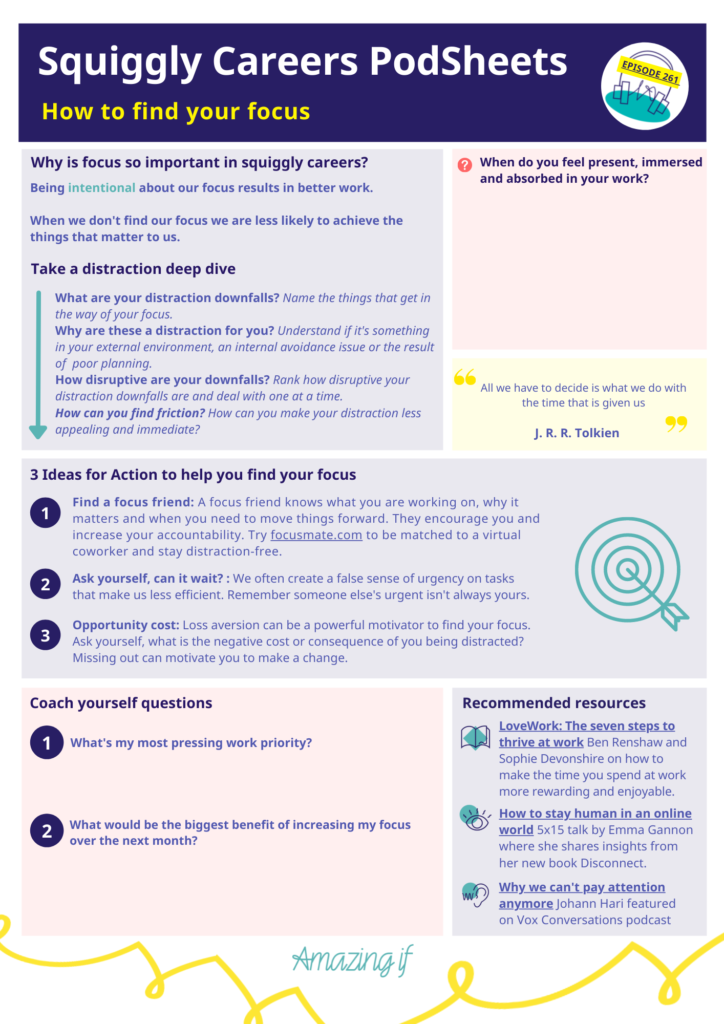
This is the second of four episodes on how to find your focus.
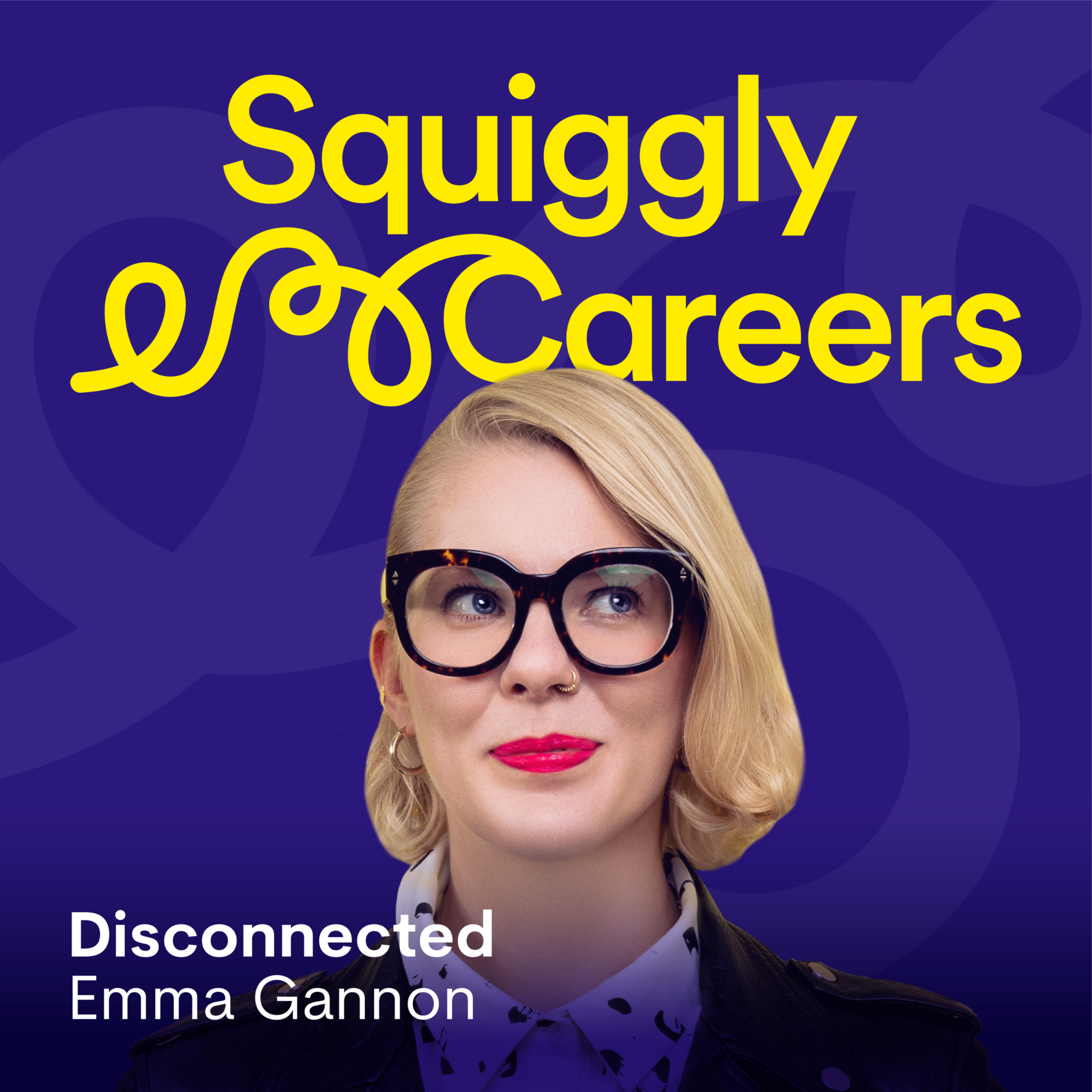
In this episode, Sarah talks to writer and podcaster Emma Gannon. Together they explore some of the key themes in Emma’s new book (Dis)connected, including how you can reclaim time for yourself, how to redefine your relationship with technology, and why disconnecting helps us to re-connect with the work that we do.
Purchase Emma’s new book (Dis)connected How to stay human in an online world.
00:00:00: Introduction
00:02:22: How to spot the signs of disconnection
00:03:16: Blurred boundaries
00:05:02: Our phone is the new daydreaming
00:06:31: The Great Pause
00:08:34: Using technology more purposefully
00:11:23: Taking accountability and making changes
00:12:57: 90 minutes of "monk mode"
00:15:03: Rediscover your true desires and your connections
00:17:39: Personal branding and self-promotion
00:21:56: Removing the "like" count on social media
00:23:44: Don't be afraid to seek out objective advice
00:25:25: Emma's career advice
00:27:02: Final thoughts
Sarah Ellis: Hi, I'm Sarah Ellis, and this is the Squiggly Careers podcast, where each week we talk about the ups and the downs of our world of work, and hopefully help you and us to navigate our Squiggly Careers with that little bit more confidence and control.
This week, we've got a special series of episodes for you which are all about finding your focus. We know that it's an area that lots of our listeners and we, quite frankly, would like some ideas and some help on; so, rather than doing just one episode, we've got quite a few for you. We've recorded one, so Helen and I have recorded one, which is very practical, full of ideas for action and coach-yourself questions; and then we've got three special guest episodes as well, which we've clustered together, because they all feel like they'll do a good job of helping us to find our focus.
So today, you're going to hear my conversation with Emma Gannon, and her latest book is called (Dis)connected, and I say latest because all of her books are brilliant. If you've not read things like The Multi-Hyphen Method, that's also a really good one to check out, very relevant for Squiggly Careers. So, Emma and I chat a bit about how to spot the signs of disconnection, what that looks like; how we can reclaim time for ourselves, who doesn't want to do a bit of that; and also, our tricky relationship with technology and what changes you can try out for yourself.
Some of the other episodes in this series, I've already mentioned the one that Helen and I have done, which is your normal Tuesday Squiggly Careers episode; but you can also hear Helen talk to Sophie Devonshire and Ben Renshaw, about what you can do to discover or reconnect with the work that you love; and you can hear my conversation with Johann Hari, talking about his excellent new book, Stolen Focus, and he is brilliant. In our conversation, we really talk about why we can't pay attention and what we can do about it.
So, I hope you enjoy today's conversation. Do let us know what you think, and I'll be back at the end to say bye!
Emma, thank you so much for joining us on the Squiggly Careers podcast. I'm delighted to have you back as one of our very few returning guests, it's very exciting.
Emma Gannon: That's so exciting. It doesn't feel like two years ago, but I'm so excited.
Sarah Ellis: And here we are. And when we say here we are, here we are in person, which just never happens, and has not happened very much for the last two years, which actually feels very relevant for our topic for today, which is all about your new book, which is called (Dis)connected. I'd love to start with, how can we spot and understand the signs that maybe we are feeling less connected than maybe we have been before?
Emma Gannon: Well, I think it comes down to our everyday joy or mental health, I think. I think the last two years have been a lot for a lot of people, and I probably would have written this book before the pandemic, but now I feel like it's more urgent and it's clearer, the divide between our everyday selves, with our family and friends, and our online selves, which can be very wrapped up in work, I think, and personal branding and promotion. And it's all mixed up together and it can leave us, I think, feeling very disconnected from who we actually are.
I've been doing a lot of work looking inwards during the last two years, and wanting to get myself back and work out who that person is, because it's all muddled up, and so the book is really about getting back to basics in many ways.
Sarah Ellis: So, that muddling up, I think, is a good description of the blurred boundaries that lots of our community and our listeners tell us they've been experiencing, particularly over the past two years. I think perhaps we understood it when it was forced on us, so whether people were doing home-schooling or caring, we felt like, "Oh, this is temporary", so we thought that there would then be maybe a return to what we knew before, or a new hybrid world that might be better. But I think these blurred boundaries seem to have stuck and they've stayed with us.
So, how can we start to regain a sense of control and put some boundaries back in place? I think that's what most of us are seeking and would like to be able to do?
Emma Gannon: Definitely, and I think it's a huge thing to really sit with yourself and be in discomfort. We're so used to living in this world of Deliveroo or WhatsApping someone and getting a reply straightaway, booking a doctor's appointment online. There are positives, but everything's instant, we're living in this urgency culture of now, now, now.
I was talking to a friend the other day and she was like, "I can't even wait for the lift anymore, I can't wait for the microwave to ping anymore". Everything seems so within our reach, but then what do we do when we are bored? And I am a fan of just sitting in that uncomfortable phase now of not really knowing. We all want to know everything all the time, it's just so overwhelming.
So, a lot of (Dis)connected isn't about digital detox necessarily, it's not about taking a whole week off and going cold turkey, but how do we get those moments in the day where we just remind ourselves, what are we doing; why are we picking up our phone; what do we want from our lives; do I like my friends? These are huge questions, but until we actually sit with them, we're just hamsters in a wheel, aren't we?
Sarah Ellis: And you talked about, actually, the loss of daydreaming, which I always find quite interesting, because there's quite a lot of evidence that daydreaming is really good for us, and I wonder whether our phone has almost become a substitute for daydreaming, just giving our brains a break and a bit of space to see where they go. They might go somewhere interesting and they might not, but that almost feels quite uncomfortable, this idea of just sitting and pressing pause for five minutes.
So, when you're thinking about this idea of daydreaming and maybe trying to make some of these changes, what does that look like practically in our working week where, as you describe in the book, there are notifications coming at us from all sides, everybody feels like they're always on, so it feels like quite a big deal to opt out of that, I think? What could that transition look like, I suppose, if we're trying to get into being more connected in a meaningful way?
Emma Gannon: Yeah. One really nice thing from getting feedback from the book already is people have been saying they've been going for walks without a podcast or without music, and that sounds so basic, but actually it's not that basic. We are so distracted, and that's the theme of the book really, is just pure distraction, and how we untangle ourselves from that.
For me, a lot in the book actually is prompts around nostalgia and, yes, we want to live in the present, and there's loads about living in the present and accepting the present moment as it is, and not always looking in the future, because that's all that social media actually is, it's us imaging ourselves in the future; that's what comparison culture is. It's, "I could do that one day. I'm not doing that now, I'm going to feel bad about myself".
So, living in the present is great, but actually in the lockdown, lots of psychologists said that because we couldn't go forwards, we had to, in some ways, go back and reflect and look at our lives. It was called The Great Pause, I think, the pandemic; but it was in a way a good thing, I think, especially for me, to actually take stock.
I've changed my definition of success, I've changed the clothes I wear, I've relooked at my relationships, I feel like I've had a major Mari Kondo moment with my whole life and career. So, a lot of it is looking backwards a little bit; what steps have I taken that I can be proud of. But also, what did I used to like when I was younger; what did I used to talk about with old friends; what music did I used to listen to before Spotify told me what to listen to every day? It's kind of getting outside the algorithm, that's really what the book is about is, "What do I actually want in my life?"
We are going through the Great Resignation, people are wanting more. Friends of mine who have said for years, "I don't like my job", are actually taking steps towards changing it for the first time. So, I think it's an exciting time and I just think the way that we look at diet culture, like I want to have a healthy lifestyle, I don't want to go on a crash diet; so, I don't want to go on a crash detox from my phone, I just want to enjoy my phone again.
Sarah Ellis: So, having almost lived and breathed the book, I feel like it's been a personal experience for you, from listening to you?
Emma Gannon: Yes, always is!
Sarah Ellis: And then, what you have done so brilliantly in the book is combined, I think, your personal insights, but also with all the expertise that you get from your brilliant guests on your podcast and the different research that you've done.
When you now think about, say, the relationship with technology and with your phone, with the internet and with social media, what are some of the good things? Because, exactly as you said, I don't feel like your book is trying to say technology is bad, or that we should all stop picking up our phones. So, what have you now been left with, now you've done the Maria Kondo-ing, what have you now gone, "This actually feels really useful [or] enjoyable [or] does bring me joy"?
Emma Gannon: So, I think it's looking at what serves you and what doesn't serve you, so looking at the "shoulds" like, "Should you be on Twitter? Should you be on LinkedIn? Is that something that your boss has told you you have to do? Is that something you enjoy?" What are the more active things and not passive things? So for me, I've cut out passive action on my phone. I don't really scroll when I'm bored anymore. It's more, "I need to go and book that dentist appointment [or] I need to go and write a really long email to my colleague with these bullet points". It's very thought out.
Okay, it's not always like that, I'm not perfect obviously, but it's a real conscious decision now to work out, "What is this for?" and also, "Does it enhance my life? Does it enhance my real life? Am I using Instagram to connect with my best friends in a deeper way? Am I commenting on their baby photos and then saying, 'Can't wait to see you, let's book in a date'?" So, it's not contained on the internet, and I know this is hard, because we've obviously not been able to see people, but even the small things like, "Am I using the internet in a way to make me more money?" For me, that is a goal. I want to make more money, because I want to have more downtime.
So, am I using my time well; am I getting on and then getting off and doing something productive instead of just literally staring at a screen, because we all know how that feels?
Sarah Ellis: Yeah, I think that sense of considered and being really intentional is so important. So, there are some things, I think, when I've started to think a bit about social media that I engage with, I learn from some places and they definitely fuel my curiosity. Those are the ones where I go, "That feels brilliant", because I can connect with people I couldn't have connected with if that didn't exist, and I learn things that I wouldn't have known, and that feels like a really positive experience.
Then, there are other things that I have cut out where I think, "All that does is lead me to compare myself", and I never feel good after that moment. I think maybe sometimes testing. I tested coming off Twitter, just to see, "Do I miss it? What's the impact of that?" and for me personally, I don't think Twitter was the right home for me. So, I don't miss it; and I came off Facebook, and I don't miss it, because Facebook was all about connecting with my friends and like you, I'm an introvert, I don't have loads of friends. So, the ones that I do have I know really well, so I don't need Facebook to connect me with my friends.
But I love Instagram, because all of our Squiggly Career listeners, everybody's such a positive community on Instagram, that's a great place to hang out, I always feel really good. So, I think almost doing that sense of, "How does it feel and how is it useful for you?" each of those different bits of technology you're using, and maybe just testing. Like you said, it feels really uncomfortable though, doesn't it? I think you said on LinkedIn, you did the turn-off of notifications and be more passive for six months, that feeling of, "Can I do this? What's going to happen if I do this?" then funnily enough, nothing happens!
Emma Gannon: Yeah. I mean, I've definitely got work through LinkedIn, so I was a bit like, "Am I shutting off opportunities?" But actually, there's that quote, isn't there that's, "If it costs you your peace, it's too expensive", or something; it's not worth it. And LinkedIn was really stressing me out, and that's just me perfectly. But absolutely, what you're saying is 100% what I'm trying to get at in the book.
It's almost not really a book about the internet, it's a book about rediscovering yourself and your triggers and your emotions, and taking some accountability. I think we need to go one step further now. We can't say, "Our phones are awful and look at the data". I mean, we know that we tap our phone 2,000 times a day and more; we know that having the phone literally on the table, like if it was on the table now between us, our cognitive capacity would be less; and we also know that it increases our desire for that materialism and it increases anxiety, it increases stress.
We know our phones are "bad", but actually it's more neutral than that; it's our habits that can be the bad thing actually, and how we can look at that and say, "I can change this". If you mute something that was causing you a lot of stress and you mute it and it goes away, it's gone. You can change it. And now, I look at my phone and I don't feel overly stressed.
I do look at someone like Mo Gawdat, who I know that you know and love as well, and how he actively doesn't watch horror movies, because he doesn't like how it makes him feel. We can choose how we dip in and dip out. I don't read the news in the morning. Test things out, for sure.
Sarah Ellis: You talked about one of the examples about thinking about your time was, 90 minutes is quite a good amount of time in terms of, it made me question, when was the last time you had 90 minutes, fully present and absorbed, to be able to do some work that you wanted to do, or work on a project that you're particularly passionate about, without being interrupted by phone calls, notifications, or interrupting yourself by thinking, "I'm just going to go and see what's on the BBC", or whatever it might be?
So, I was thinking, well, if we all knew that it's really good for us to have 90 minutes to work on a project that's important as a team and you label that in your calendar, "Monk mode, 90 minutes, I'm working on this" and then everyone leaves you alone.
Emma Gannon: It's amazing.
Sarah Ellis: Yeah.
Emma Gannon: Because, people don't believe me when I say that I write my books in 90 minutes a day. I don't spend eight hours --
Sarah Ellis: I still think that's impressive, having written a book, I still think that's impressive!
Emma Gannon: I mean, yeah, maybe it is, but I think I'm quite a fast worker when I'm focused. And for me, 90 minutes uninterrupted is even better than having five hours of checking my emails here and there. And Oliver Burkeman, who is literally the guru --
Sarah Ellis: He's so good, isn't he? We had him on the podcast.
Emma Gannon: He's so great, and he taught me the three- to four-hour rule which is, if you have three to four hours ringfenced in the day, and I don't know if I could do monk mode for three hours, but I could try, he basically says the rest of the day could be absolute chaos. You could have your dog weeing everywhere, you could have a new-born baby in the corner, I mean maybe not! But you could have your whole world go up in flames around that three-hour block, and that's just made me feel so much better, because what I love about his work is just the imperfect nature of it all, and how we're starting to embrace the messy mode and not be so obsessed with routine; because, the more I focus on routine, the more upset I get that I can't do it.
That's why I wanted to look at the digital detox thing, because I used to do a digital detox and I would fail at it, and we don't like failing as humans. So, I would always feel like a failure, and now I've found a way of, "I make my own rules and I stick to them and that's great".
Sarah Ellis: When Oliver Burkeman was talking to me about, "If there's one thing you can do", he was saying, "what's your one non-negotiable?" but that non-negotiable has to be purely for you. So it can't be, "I'm getting something ticked off my to-do list" or, "I must do this exercise" or whatever; what is the one thing that you're really motivated by, and then how could you make that a non-negotiable?
I also think we tell ourselves stories in terms of what we think is true, and those beliefs feel very real. I think I got to the point of last year of thinking, "I don't have time to exercise. I don't have time to physically stay as fit as I would like to be", and I think sometimes we've got to almost say out loud, "What are those things?" those beliefs that they feel very real and they almost feel out of our control to change.
But by saying them and then thinking, "What would have to change? What would I have to do differently for that to not be true?" and really challenge those beliefs, which will feel, to your point, uncomfortable, difficult, you will probably need some help and support to make those things true, but really going, "That can't be true. It can't be true that I don't have time to exercise for 45 minutes, 3 times a week, that can't be true. I need to find exercise that motivates me, that I enjoy, that is convenient, that does fit in, and then I need to choose to prioritise it".
When you start to then do those things and really challenge yourself on your point of connection, because I actually get quite a lot of connection from doing exercise with other people. I don't like exercising by myself, because I used to like team sports. So again, I feel I've lost a sense of connection with exercise, I think because I don't want to exercise by myself; and giving myself a tiny bit of break, the last two years it has been much harder to exercise with other people. So, I think it's just challenging, I think, some of those beliefs that we believe are so out of our control and feel really real.
Emma Gannon: It's so true, and that's such a good point, to find support and find connection in it, because I don't think willpower alone is enough. That feels so bad, doesn't it? It's like, "Oh, you should be able to do that, you should have more willpower". We live in a really crazy time at the moment, so willpower alone is not enough.
But yeah, asking for help, connecting, reaching out, a lot of the prompts in (Dis)connected are about reaching out to people and being in that discomfort of saying, "Hi, I'm lonely [or] do you want to meet up", or even messaging someone you haven't spoken to for two years if you're thinking of them. These are really difficult things, because if we're being honest, it's much easier to just send an emoji to someone quickly, or opt out of the things that bring you connection. It can make us lazy in those ways of ignoring our true desires as well. It's easier to stay in a job you hate; it's harder to leave.
Sarah Ellis: One specific area which you talk about a bit in the book, but you talk about generally, I think, in a really useful and interesting way, is self-promotion and personal branding. We get asked about it a lot and I don't think I have a really good answer at the moment, but I think people feel a pressure now that they should be building up their followers on Instagram, or have an incredible profile on LinkedIn, or think about how they share their work very publicly. And particularly, I often get asked it in the context of being an introvert.
So, on one hand people, I think, feel they may be proud of their work, but they don't really feel comfortable shouting about it, or maybe don't want to do that, but maybe think that they should do that; and I just wondered, I feel like you have thought about this a bit, and also you have a really interesting, in terms of your day-to-day, where those two things have to go hand-in-hand. You spend probably a lot of time, I'm guessing, that people don't see writing, researching by yourself; but then a big part of what you do is also making sure that people see it and share it, and come become part of it.
How can people think about, for themselves, what does it mean in terms of personal branding and our relationship with self-promotion? I know it's not an easy one, but I know you've got some good words of wisdom on it.
Emma Gannon: Yeah, well it's interesting even how you did say "should", like people feel like they should need one. To me, it's an interesting place to come from, because I think if you feel like you should have a personal brand, then you're getting off on the wrong foot almost, because it's coming from a place of, "I probably should do that".
So I think, for me, it's always about connection. It has to be, at the end of the day, to spread your message, because human beings aren't brands. We can call it a personal brand, because that's sort of what it is. And when we're on the internet, and even if you've got a Facebook profile picture, you have some sort of personal brand, because people are seeing what you look like, what you're saying, your tone of voice, what you share, your identity, the things you like, the things you follow; that is some sort of personal brand.
I think it has to come from a place of, "What do I want to say and what do I want to achieve by saying this, and who do I want to reach?" and those are the three main things. That makes it a strategic exercise, which means, "I'm going to launch a business [or] I'm going to share my music [or] I'm going to write a book". There needs to be a goal, and I think the goal should be connection. But you might as well be a logo otherwise, just be the Dove logo and sell soap, because that's fine; brands do that every single day. But we're humans, so there has to be something more.
For me, I really lean into self-promotion, I don't feel apologetic about it anymore. And actually, I've gone even further with it. I've separated out my profiles, so I have a personal Instagram and a public Instagram. So, I've got my shiny career self on one of them, but I'm like, "Well, that is me, that's my outer layer". It's not fake, it's not inauthentic, it's a part of me, it's me on a good day and that's what I want people to see, I suppose. I don't think there's anything wrong with that. It's still me being real, but it's just not the inside of my house and what I'm having for breakfast. I think that's okay to have two different selves.
Sarah Ellis: I think you also gave an example in the book of, it's also not about quantity or volume. So, if you connect with five people in a really meaningful way, that is just as, or if not more important, than connecting with 500 people. I think sometimes we get caught, don't we, in how many likes, how many comments, how many connections, and it feels a game of quantity.
It challenged me to think a bit about this as I was reading your book, I was thinking, "I would much, much rather be really connected and hopefully have some sort of connection also in personal, real life, with 10 people than I would with 100 people". But maybe when we think when we share our work, or the things that we do want to talk about that we're proud of, that it's only successful if it reaches lots and lots of people.
So, I wonder if that's one of the things that we also have to decouple ourselves from, is thinking -- I even fall into this trap now sometimes where I think I'll share something on LinkedIn that I really care about, and if maybe only 100 people have read that article, but maybe previously 500 people have read one of my articles I'll think, "Maybe I didn't do a good job with that article. Maybe it wasn't as good as it could have been. Does that mean that I'm not doing a good job?" and all of these spiral thoughts can kick off in your head versus, "Maybe I really helped those 100 people".
Emma Gannon: Exactly. That's why I've hidden the "like" count on my Instagram and I absolutely love it, because I'm not ranking or rating myself and no one else is, and that's a very weird way to move through the world, getting likes for different things that you share. I joke in the book that someone I know literally spoke about this pregnancy announcement like it was content, and I was like, "That's so weird that that performs well, what the hell is that about?"
But I've noticed, on my Instagram, that if I post something about a charity I really care about, hardly any likes. If I post about a pair of shoes I've bought, loads of likes. That doesn't mean that one is better than the other, that doesn't mean anything. All it means is that was more visible and that worked better with the algorithm.
So, I think taking likes off is a really good start, because it makes you less self-conscious, because we are in a world where we've got the Kim Kardashian types of the world, where having millions and millions of followers seemingly is like the American Dream and success. I don't really think that's success, and I think we want to go smaller a lot of us. Growth is not my main vanity metric anymore, but then that comes from me seeing what that look likes and getting it, almost, and then realising nothing is really there at the top of the mountain.
So, yeah, and I use examples in (Dis)connected, actually. There's a YouTuber that I know who has, I think, 12 million subscribers on YouTube, literally living the dream, if you want millions of people to see what you're doing; I'm sure it's a great ego boost. But she has a private Instagram that actually I follow, and it's lovely seeing her real self behind the scenes. And I know for a fact she started that because she felt disconnected.
Sarah Ellis: That's so interesting. We always finish all of our interviews asking about career advice, but are there any other practical actions, or things that you have tried out, that you include in the book and you've tested and experimented with that you'd like to share with our listeners; is there anything else you'd like to encourage people to have a go at?
Emma Gannon: I would say to seek out help in other ways, if you're self-employed especially. Actually, no, this goes for everyone and anyone who works in any way, to look at non-traditional means of help, and this is very up your street, but I have experimented with life coaches over the last few years and just not even necessarily signing myself up for six months of coaching, but just one-off sessions, trying things out, having experimental conversations, talking to someone that isn't my partner and isn't my friend and isn't my colleague; someone else, just some sort of third party; not a stranger necessarily, but just someone who could be objective.
I find that you can be yourself, you can say more of the truth, you can get under the skin of it a little bit more, not necessarily therapy, although therapy is probably a really good one as well, but there are so many people out there who could help and share the knowledge. For me, I'm really trying to look at collaboration more than competition. That's always been, for me, a really big part of my values, is share other people's work, connect with other people; and if someone's doing something similar to you, join forces. This is the goal.
I think there's nothing lonelier than wanting to be the one at the top. It's like, "Oh, cool, you're going to be really successful and literally on your own in a room". Build a network.
Sarah Ellis: And so, just to finish our conversation today, we are going to share with all of our listeners five coach-yourself questions, which Emma and I are going to write together, and we'll share those on Instagram and LinkedIn and all the usual places that you find us. Or, if you join PodPlus, we'll talk about them in the workshop.
But just wanted to finish, Emma, asking for your best piece of career advice. So, this doesn't have to be to do with connection, though of course it can be, it might be advice that you've been given that's really stuck with you, or it can just be your own words of wisdom that you just feel have been really helpful for you.
Emma Gannon: I don't know if this has already been said, but it's something that I'm really trying to lean into, which is celebrating my small wins more and more, because I think I was always really obsessed with the bigger goals. But it's a really good feeling at the end of a Monday, or end of a Tuesday, random day, just to sit down and write down a few things that went well. They can be really small, but otherwise I think you're going to risk missing out on a lot of it, and it will all just go by in a whirlwind.
Sarah Ellis: Well, it's similar and unconnected, which is relevant, Martha Lane Fox said something different that inspired one of the exercises that we actually have in You Coach You on resilience, which is very small successes, and we always say to people, if you write down every day one very small success you've had, personal or professional, it doesn't matter what part of life it comes from, everybody has one very small success every day, it just sometimes just passes us by, or it feels hard to remember when we've had a tough time.
But the more you start to wire your brain to see them and spot them, you'll find you have way more than one every day. So, I think it's a really nice way to close our conversation today.
Emma Gannon: Well, thank you so much, and it's so true, I think, that the things you pay attention to are the things that grow in your consciousness, ie try and notice one nice thing that happens every day as well. So, now I'm noticing these little acts of kindness on the tube, or in everyday life. Just change your perspective a little bit and it really helps.
Sarah Ellis: I feel like your level of calm and Zenness would be very nice to embody for a day! We'll include links to Emma's book, (Dis)connected, but also to Emma's newsletter, which is always one of the ones that I read. I think it comes out monthly on a Sunday, is that right, Emma?
Emma Gannon: That's right.
Sarah Ellis: It's a newsletter, and I'm sure lots of you already listen to Emma's podcast, because we know, because people tell us! But if you don't, we'll include a link to that as well. But thank you so much.
Emma Gannon: Thank you, thanks for having me.
Sarah Ellis: Thank you for listening to my conversation today with Emma. I hope it does help you to disconnect and maybe reconnect with the work that you do. If you do get a moment to rate, review and share the podcast with other people, we always really appreciate it. We read every review, and it also helps us to continue to share Squiggly with more people in more places. So, thank you.
But that's everything for now and we'll be back with you again soon. Bye for now.
Sign up to the Squiggly Careers Newsletter and get our latest ideas, tools and inspiration every week - all in one place, straight to your inbox